By: Irina Ceric
What are zombie injunctions?
Interlocutory injunctions are, by definition, meant to be temporary. In theory, injunctions are intended to prevent harm while a lawsuit proceeds. But court orders restraining land defence and protest actions often remain in place indefinitely, the consequence of a tacit understanding that no trial will – or was ever intended to – take place.
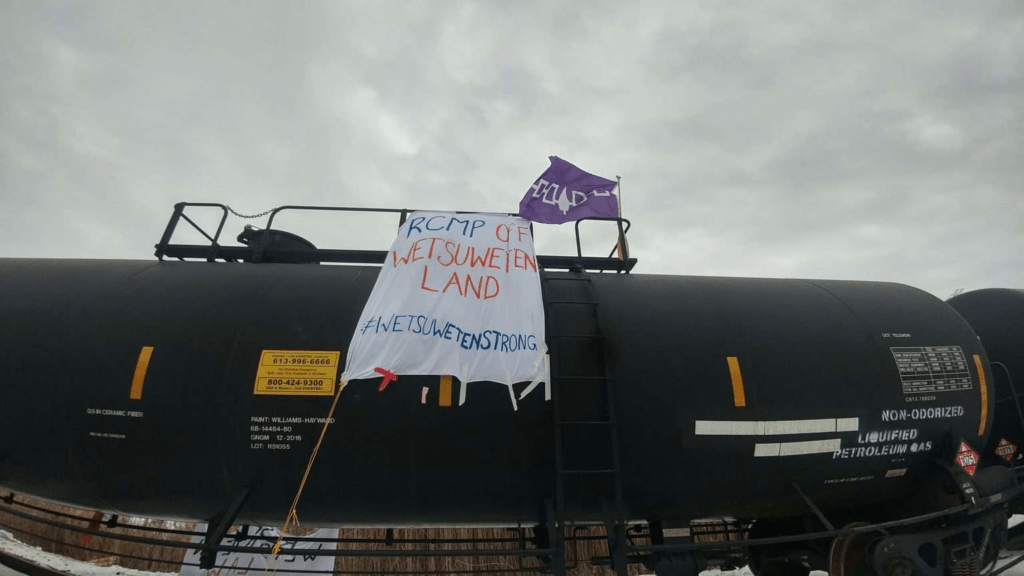
We can think of these as ‘zombie injunctions’ – lingering court orders that lurch around seemingly alive but with no active lawsuit behind them to actually give them life. Sometimes police threaten to re-animate these zombies, warning organizers and protesters of the existence of antiquated injunctions that should have been killed months or years earlier. For example, organizers of a Palestinian solidarity protest at the Port of Vancouver in late 2023 were concerned that an injunction issued more than three years earlier to criminalize Wet’suwet’en solidarity actions at the same port could be deployed against them. More on this below…
Why do zombie injunctions happen?
The main driver of zombie injunctions, as alluded to above, is that in practice, injunctions are often a legal means to an end. Although an interlocutory or interim injunction is not supposed to be a final remedy, courts hearing applications in cases involving land defence or protest actions often issues orders that do function as a resolution of the actual ‘problem’ driving the lawsuit – interference with resource extraction projects. Once the injunction is issued, especially if the project is then successfully pursued and/or completed, there is little reason to proceed with the underlying legal action. Corporations and governments simply don’t have a lot of incentives to move forward with costly, lengthy, and uncertain litigation against defendants who likely cannot afford to pay damages.
Another reason is that injunctions targeting protest actions are often issued against “John and Jane Doe”, meaning that there may not be named defendants to keep track of the status of a lawsuit. But even if one or more individuals are named, they may not have the time or resources (especially lawyers – and money to pay for them) to devote to challenging the claim underlying an injunction that may appear to have run its course.
Are zombie injunctions really a problem?
Zombie injunctions are an example of how seemingly neutral legal tools can be weaponized to strengthen and normalize the coercive power of already powerful actors. Court orders left lurking in the wake of seemingly abandoned lawsuits can cause confusion and uncertainty, chilling expression by casting a pall of legal ambiguity over protest and land defence organizing. The fact that police are unlikely to deploy a stale injunction issued during an earlier and unrelated set of actions does not neutralize the legal risk: an ambiguous threat can still be a potent one. After being contacted by Vancouver organizers asking if the earlier port injunction was still in effect, the only immediate answer I could give them was “probably.” Getting a better answer turned out to be surprisingly difficult.
A zombie injunctions case study
In the summer of 2024, my research assistant (Windsor Law student Emily Kydd) and I attempted to track the status of fourteen injunctions that had been issued to block or prevent Wet’suwet’en solidarity protests and blockades four years earlier (this number does not include the original injunction order granted to Coastal GasLink in 2019 and enforced on Wet’suwet’en territory. Seven of these injunctions were issued in BC, three in Québec, two in Ontario, and one in each of Alberta and Manitoba. Three injunctions were obtained by a government entity (the BC Legislature, the Province of BC, and the Attorney General of Québec), while the remaining eleven were all major infrastructure or transport-related private corporations and Crown Corporations (e.g. BC Ferries, CN Rail).
After much digging, the best answer we could come up with was that 12 of 14 court orders were likely still in effect. One interim injunction, issued for ten days, had simply expired. Of the other, mostly interlocutory orders, in only one, a CN Rail injunction obtained in BC, had a plaintiff filed a notice of discontinuance, putting an end to that proceeding against John Doe, Jane Doe and persons unknown. The other cases we could track had been left hanging, most with no activity at all after the issuance of the injunction. None had proceeded to anything close to a trial.
Accessing this information was slow and frustrating, an access to justice challenge even for two people with legal training, time, and a research budget. While the court websites of some provinces now include databases of case information, there are often fees for viewing documents that have been filed. Some websites only provide an overview of dates and events, with most documents only available in hard copy at a courthouse registry. Other provinces do not make any court filings information available online, meaning that phoning or visiting a court registry is the only way to ascertain the status of a lawsuit or injunction. And of course, all of these methods require some familiarity with court processes.
So how do you kill a zombie?
The rules of civil procedure which govern lawsuits and injunctions vary from province to province; this is only a general overview. There are two ways to kill a zombie injunction: terminating the underlying lawsuit or dissolving (cancelling) only the injunction order. Note that court applications to amend some parts of an injunction are also possible (e.g. changing the geographical scope), but that is not our focus here.
To terminate the underlying claim, a defendant can bring a motion to dismiss a civil action based on the plaintiff’s failure to pursue the case (in other words, for not completing any of the steps necessary to bring it to trial in a timely way). Other grounds for dismissal may also be available, but you’ll need to get detailed advice about how exactly this process works in your province from a local lawyer.
It’s also possible to apply to a court for an order dissolving an injunction on the basis of delay. In a case involving anti-logging protests in Clayoquot Sound, an injunction granted in 1991 was dissolved three years later because no steps had been taken in the underlying action. The court ruled that the injunction order should not be permitted to remain in place indefinitely and ordered that it be dissolved some three months after the date of the decision.
A version of this post was published by The Breach on January 19, 2026, titled “Police could use ‘zombie’ court orders to shut down social movements.”