Join 8th Fire Rising for actions on July 1 in Toronto and Montreal, and catch up on our new research into US military investment in Canadian mining, one year of 8th Fire Rising, a federal deregulation comment period closing July 22, and more resistance news from across the country.
In this Update:
- July 1 Actions in Toronto and Montreal
- New Research: Pentagon Investing in Canadian Mining
- One Year of 8th Fire Rising and Beyond
- Critical Minerals for Defence: Report Back from National Security Conference
- Comment Period on Federal Discussion Paper, “Getting Major Projects Built in Canada”
- Canada’s Missing Major Project: A National Care Economy Strategy
- Resistance News
July 1 Actions in Toronto and Montreal
Join 8th Fire Rising for two actions in Toronto and Montreal on July 1, 2026.
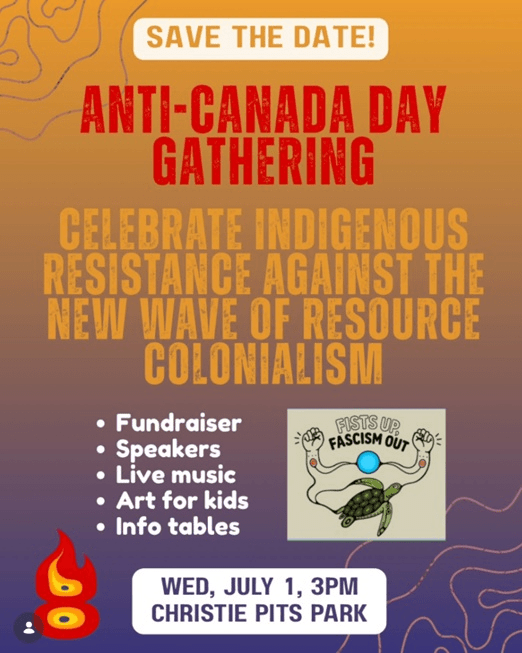
Anti-Canada Day Gathering (Toronto)
When: July 1, 2026 at 3pm
Where: Christie Pits, Toronto
Grab your friends, wear your orange shirt and join us to celebrate Indigenous resistance to the new wave of colonialism launched by Prime Minister Banker Daddy’s Bill C-5, Building Canada Act. Dozens of projects have been fast-tracked and dozens of communities impacted by this legislation that is overriding environmental, Indigenous, and labour rights across the country. It is a flood of resource colonialism.
Come out for live music, art for children (and adults), speakers and information tables sharing more about the “Projects of National Interest” that have been selected by the federal government to steamroll ahead. If you, like us, want to see the “National Interest” defined as respecting treaty rights, investing in the care economy, and building a climate-friendly energy policy for all, then you won’t want to miss it.
See the Toronto event on Instagram →
Fists Up, Fascism Out (Montreal)
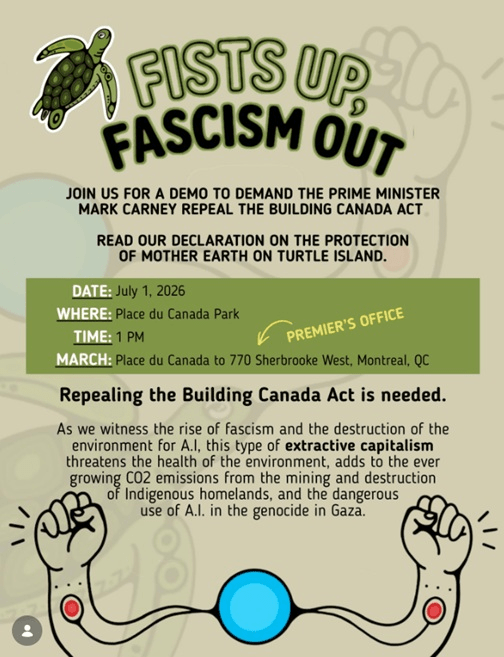
When: July 1, 2026 at 1pm
Where: Place du Canada Park, Montreal
We will be marching from Place du Canada to the Premier’s office at 770 Sherbrooke West, Montreal.
Repealing the Building Canada Act is needed as we witness the rise of fascism and the destruction of the environment for AI. This type of extractive capitalism threatens the health of the environment, adds to the ever-growing CO2 emissions from the mining and destruction of Indigenous homelands, and the dangerous use of AI in the genocide in Gaza.
See the Montreal event on Instagram →
New Research: Pentagon Investing in Canadian Mining
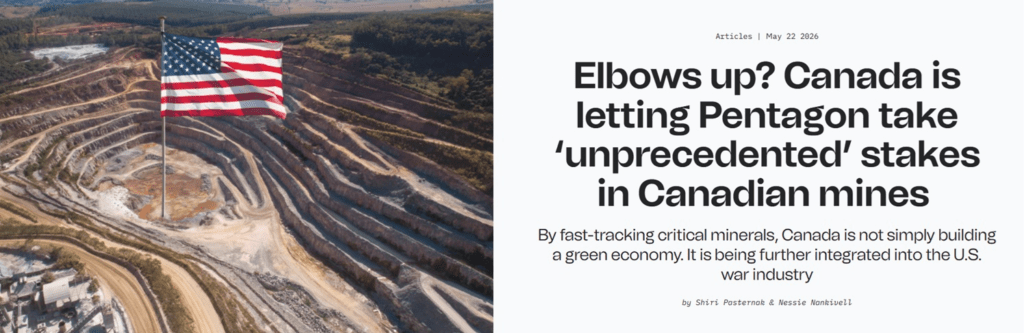
Check out this new piece in The Breach by Shiri Pasternak and Nessie Nankivell on the unprecedented direct investment by the US Department of War into mines in Canada. According to legal experts, the US is taking “possibly unprecedented” measures to secure ownership over Canadian mines, turning Canada — and the First Nations from whose lands the minerals are sourced — into a US mining territory. All the while, the Canadian government is helping fund and fast-track these projects.
See also Nessie Nankivell’s longer piece in Transition Security Project, Military Minerals: How US Military Demand Is Intensifying Extraction on Indigenous Lands. She writes:
“The US has long treated Canada as a reliable source of minerals for military supply chains; this trade relationship is nothing new. What is new is how the US government is securing access to these minerals. Rather than relying primarily on indirect tools such as subsidies or loans, the Pentagon has begun purchasing direct ownership stakes in Canadian mining companies, an approach that extends US state influence more directly into the private market. This comes as the US escalates yet another illegal war in West Asia and continues its Cold War rivalry with China. As Canada tries to claim economic independence from its aggressive southern neighbour, the Pentagon’s unprecedented investment strategy could have significant effects on the Canadian critical mineral industry — shaping where, why and for whom those minerals are produced.”
One Year of 8th Fire Rising and Beyond!
8th Fire Rising formed in the aftermath of Mark Carney’s election and the subsequent flood of omnibus legislation attacking Indigenous rights, labour rights, and environmental protections. Our research then shifted its focus to analyzing how this legislation was being used to fast-track or merely de-risk major projects.
In March 2026, we launched our PONI Map, an open-source database focused on the slate of infrastructure announced as part of Prime Minister Carney’s push to streamline, promote, de-risk, and fast-track infrastructure in Canada. This project seeks to map the PONIs and track their development to get a better sense of the kind of society this infrastructure seeks to build: Are they climate resilient or conscious? Are they a supermarket for global capital? Who owns these projects? We have been tracking data across 15 criteria to try to answer these questions.
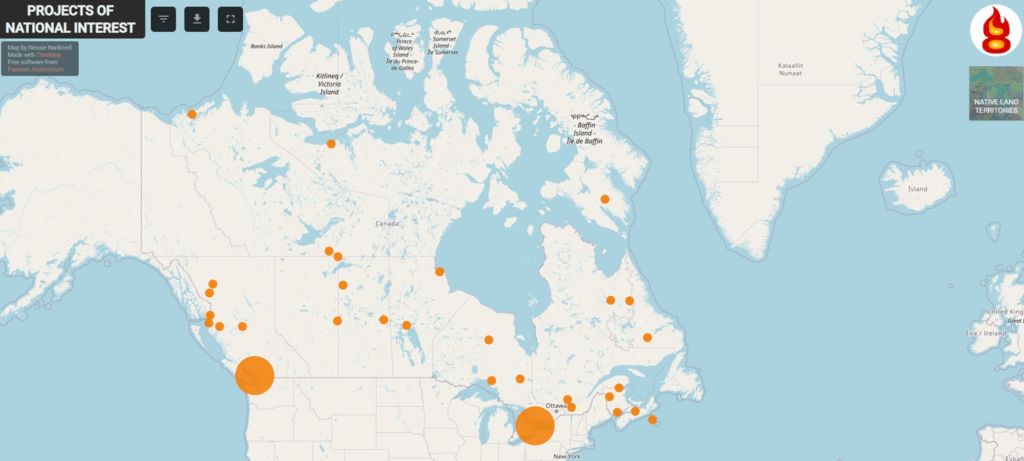
Moving forward, our research will begin to focus on the impacts that these legal and infrastructural developments are having on communities and workers across the country. We will also be updating the map shortly with newly announced projects. In April, we organized an event in Toronto, From Gaza to Gitxsan, with some of our governing council members.
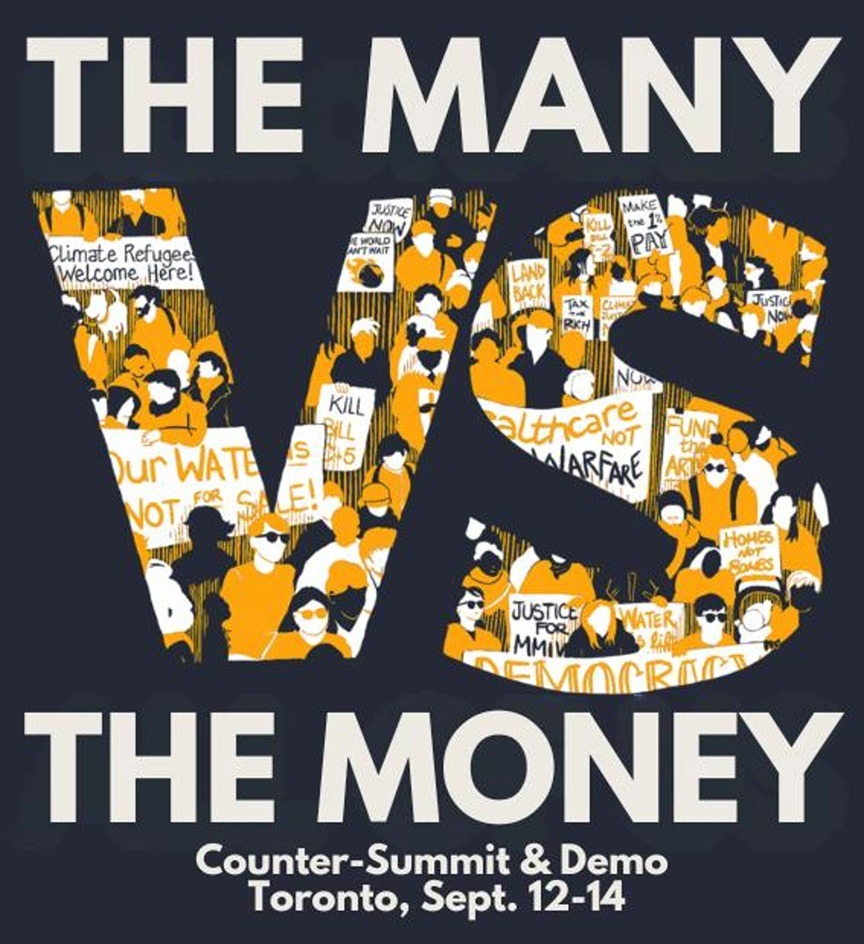
Our biggest swing yet is coming up in the fall. We are convenors of a major coalition to organize a counter-convergence against Carney’s Investment Summit in Toronto on September 14–15, 2026. Save the date and stay tuned for more details!
Critical Minerals for Defence: Report Back from National Security Conference
Two of our members attended a recent conference held in Toronto on June 9 and 10 on “How Defence Spending Is Driving Opportunities For Critical Minerals.” The conference was organized by Energy and Mines, an Ottawa-based, Canadian-owned company, for the purpose of connecting the mining, defense, government, and finance sectors. We learned a lot about how the trillion dollars in defence spending announced by Carney is warming up the plate for more mining, more war, and tougher conversations about whether “transition minerals” are a thing of the past.
Comment Period on Federal Discussion Paper, “Getting Major Projects Built in Canada”
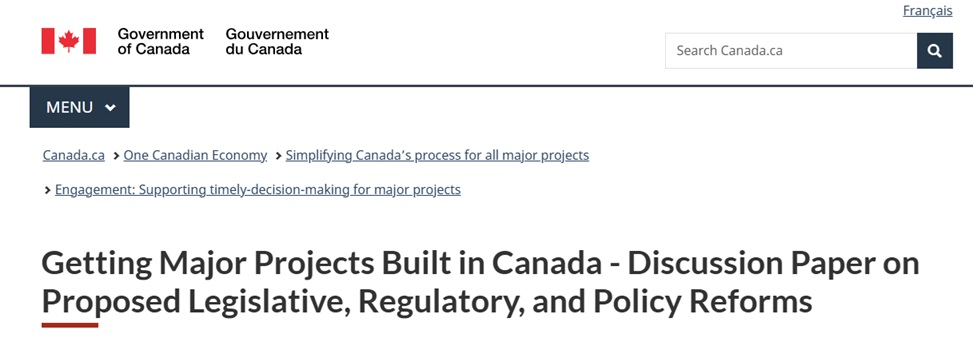
On May 8, 2026, Canada released a Discussion Paper for public engagement on proposed changes that eviscerate environmental protections to fast-track major projects, while prioritizing speedy approvals over meaningful Indigenous consultation and consent. Canada is accepting comments until July 22, 2026.
Some of the proposed changes include:
- No more independent Impact Assessments for pipelines and nuclear: pipelines and transmission lines will instead be reviewed by the Canadian Energy Regulator, and lengthy pipelines will be pre-approved by Cabinet “at the beginning of the decision process.” Nuclear and uranium projects will be assessed by the Canada Nuclear Safety Commission instead of the Impact Assessment Agency, which the Ontario Rivers’ Alliance describes as “the fox guarding the henhouse.”
- “Federal Economic Zones” with pre-approved projects: Canada wants to create zones where Cabinet can pre-approve certain types of developments. This closely resembles Doug Ford’s Special Economic Zones, which are the subject of a recent constitutional challenge.
- Rolling back protections for fish and species at risk: the Discussion Paper indicates a shift toward greater reliance on offsetting fish habitat, when the priority should be preventing harm. The Cabinet will also be able to make exemptions to the jeopardy test for species at risk. The jeopardy test prevents the government from “willfully approving extinction”; bypassing it appears to replicate the US’s “god squad.”
The proposed changes double down on the same colonial, extractive agenda laid out by Bill C-5 and echoing across many bills sweeping the provinces. Like Ontario’s Bill 5 and Canada’s Bill C-5, it includes the use of Henry VIII clauses that will allow Cabinet to decide when and to whom laws apply. Shortened timelines, exemptions from Impact Assessments, and the increase in Cabinet’s discretionary powers undermine meaningful Indigenous consultation, free prior and informed consent, treaty rights, and Indigenous jurisdiction.
Send your feedback on the proposal to engagement@pco-bcp.gc.ca by July 22, or use West Coast Environmental Law’s email tool.
Canada’s Missing Major Project: A National Care Economy Strategy
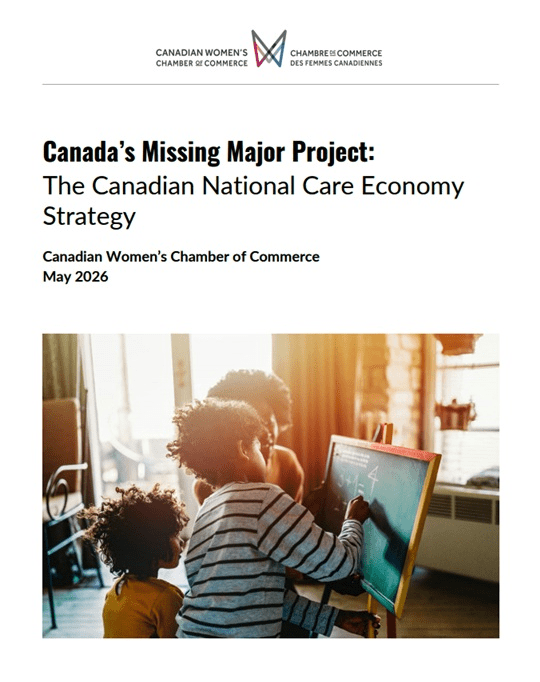
When Canadian politicians talk about “Projects of National Interest,” they always have the same kinds of infrastructure projects in mind: ports, pipelines, roads, and powerlines. It’s important to note that while less than four percent of Canadians work in extractive industries, about 75 percent of Canadians work in the service sector, much of that being forms of care work: nursing, childcare, teaching, home support, and other forms of work that sustain everyday life.
Despite being necessary for life, care work remains among the most precarious and poorly paid work. Women, racialized workers, migrants, and temporary workers make up a disproportionate share of the care workforce, often struggling to earn a living wage caring for others and trying to support themselves and their loved ones.
If infrastructure is what makes life possible, then there is no question that care work is vital infrastructure. Yet, when governments talk about strengthening the economy through infrastructure investment, they keep coming back to the same colonial playbook: more mines, ports, and pipelines.
Recognizing this contradiction, the Canadian Women’s Chamber of Commerce (CanWCC) has proposed “Canada’s Missing Major Project: The Canadian National Care Economy Strategy.” Their proposal poses a key question: what if care was recognized and valued as economic infrastructure?
Resistance News
LNG: Not in Our National Interest
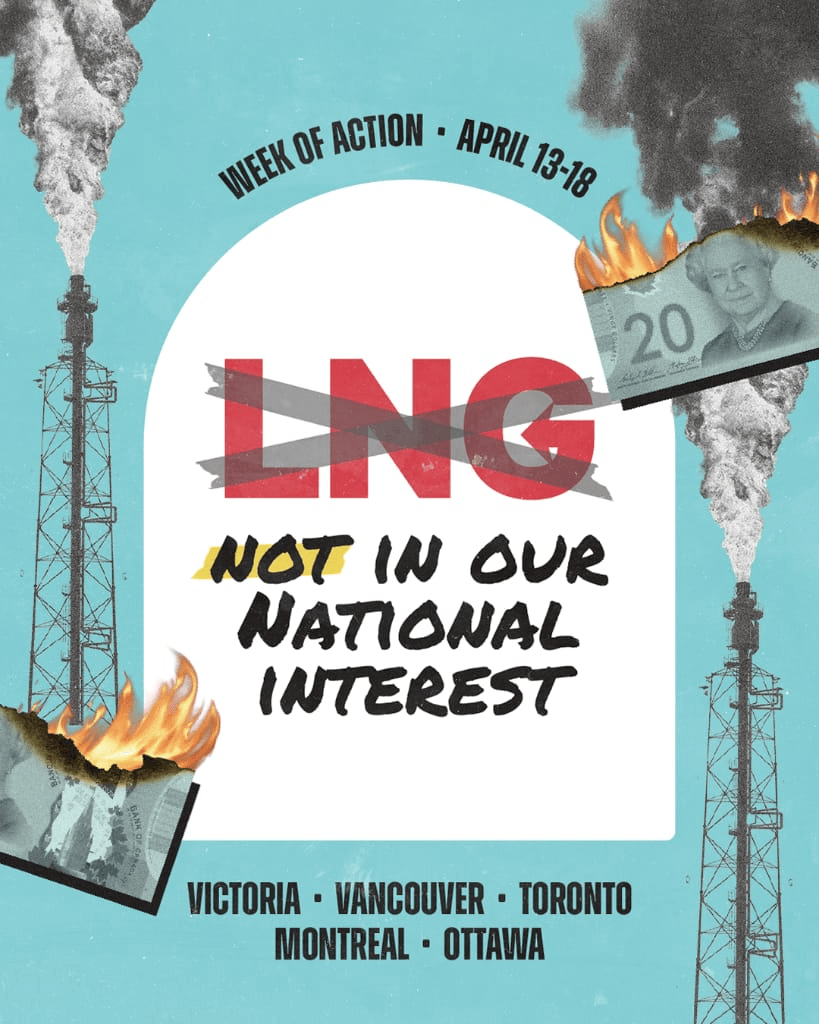
This past spring we worked on a national campaign to stop public subsidies for the expansion of privately owned LNG development. In April 2026, there were actions in five major cities across Canada (Ottawa, Montreal, Toronto, Vancouver, and Victoria).
Click here for a video clip from the rallies.
You can also listen to 8th Fire Rising co-founder Eve Saint interviewed on Green Majority Radio discussing the LNG: Not in Our National Interest campaign, with Emiko Newman and Stefan Hostetter.
United Nations Permanent Forum on Indigenous Issues
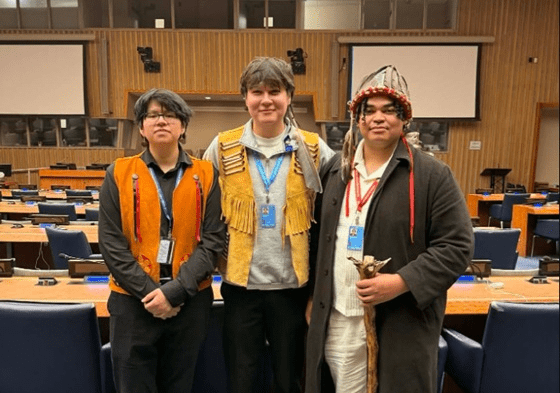
The 25th session of the UN Permanent Forum on Indigenous Issues took place from April 20 to May 1, 2026, with this year’s theme focused on “Ensuring Indigenous Peoples’ health, including in the context of conflict.”
Okiniwak, a youth-led movement uniting First Nations youth across Canada to advocate for FN equity and equality, sent a delegation. So too did Here We Stand, “a grassroots movement to protect our inherent rights, our treaty rights, our ways of life, the land, the water, and the animals for the current, and all future generations.”
You can watch highlights of the proceedings and clips of the powerful testimony given by Kohen Mattinas and Ramon Kataquapit. Here are some of the reflections they shared:
“Over the past two weeks, we learned so much from our relatives across the globe. We heard about the realities they face in their regions and the strategies they are leading in their own communities… We are stronger when we come together in unity. It was powerful to be surrounded by Indigenous Peoples from around the world and to see the pride each person carried from and for their home. A common thread that connected us all was the absolute love for our people, our youth, and the lands we come from. It was such an experience to learn the workings of the UNPFII and to make the most of this opportunity by meaningfully and accurately bringing forward the voices of our homes and the matters affecting our people at the international level.”
Read their full reflections →
To support their powerful journey, please follow them on social media: Follow Okiniwak | Follow Here We Stand
Janelle Lapointe’s TedX Talk: “(Re)imagining Indigenous Economics for the World We Deserve”
“Disrupting the false narrative of Economic Reconciliation has been at the centre of my heart and work, and it’s been critically important to me to find ways to share it in a variety of formats! This was a fun one!” — Janelle Lapointe, Climate Campaigner for David Suzuki Foundation
If you are planning an action, attending a rally, providing analysis, or want to share info, please email us at comms@8thfirerising.ca.
Sign up for updates and connect with us through our website contact form.
Chi Meegwetch.