BC’s Bill 14, Renewable Energy Projects (Streamlined Permitting) Act, was first introduced by the province’s Energy Minister Adrian Dix on April 30, 2025. It passed and received royal assent May 29, 2025 despite no consultation with Indigenous nations even though there were assurances made to the First Nations Leadership Council that their constitutional rights would be enshrined in both Bills 14 and 15. Like in other provinces, this legislation was passed at an alarming speed due to pending “unprecedented trade threats” from the Trump administration’s tariff threats.
The aim of the Act is to accelerate the permitting of renewable energy development in the province. It is specifically meant to help the province reach its goals outlined in the May 2025 Clean Power Action Plan. The streamlining of such projects will stem from their exemption from existing environmental law and regulation, including the Environmental Assessment Act. It also vests more power in the British Columbia Energy Regulator, making the organization the ‘single-window’ through which projects pass for approval (much like Bill 15 does).
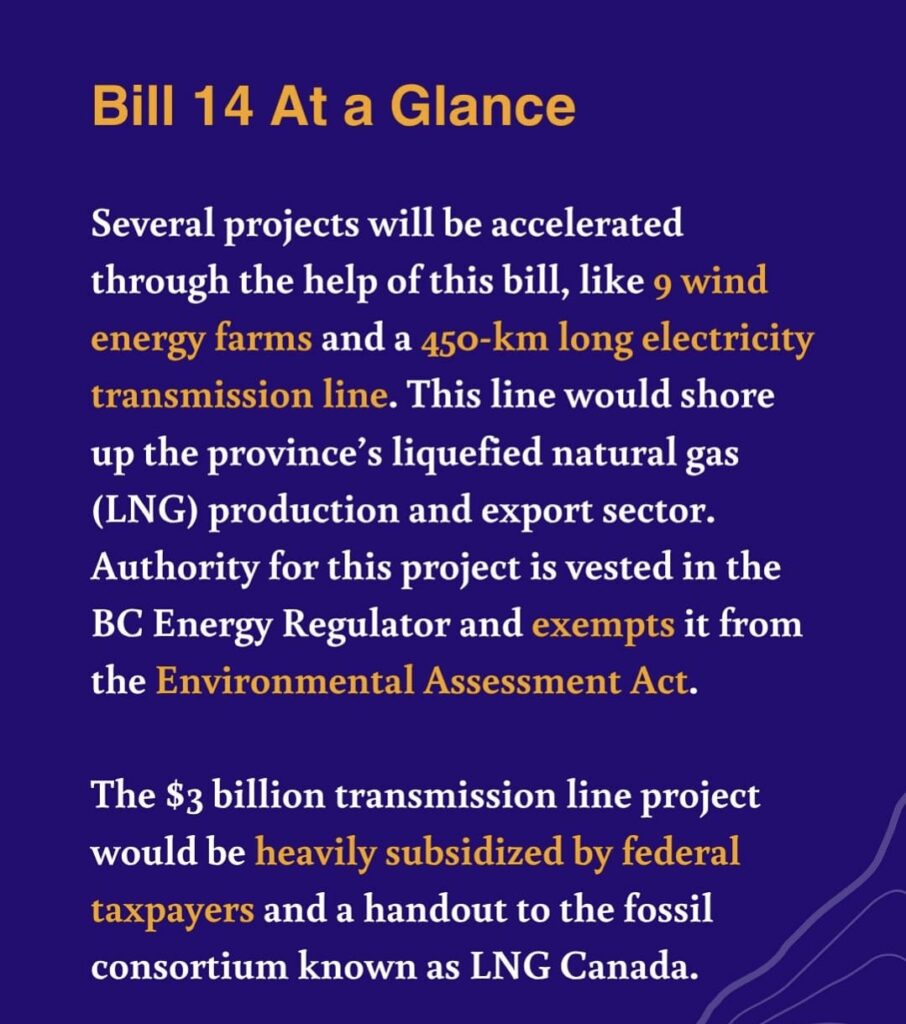
According to Section 2 of the bill, several specific sets of projects will be accelerated through the passage this bill: select wind energy projects, the North Coast Transmission Line project, and later ‘prescribed renewable energy projects.’ The first set refers to nine wind energy farms selected by the British Columbia Hydro and Power Authority through its 2024 call for power.
The second, however, is a 450-km long electricity grid called the North Coast Transmission Line Project (NCTL), which would upgrade and construct a power line between Prince George and Terrace. This electrification project will help shore up the province’s liquefied natural gas (LNG) production and export sector. The $3 billion transmission line project would be heavily subsidized by federal taxpayers and serve as a handout to the fossil consortium known as LNG Canada: Shell, PETRONAS, PetroChina, Mitsubishi Corporation, and Korea Gas Corporation.
This electrification of fossil firms has been opposed by environmental groups claiming that this is just an indirect government subsidy to the member firms who make up the LNG Canada consortium. Many environmental advocates are claiming that this is just a greenwashing stunt. In climate activist Isabel Siu-Zmuidzinas’ words, “how we build out clean energy matters and it cannot come at the expense of environmental protection or be used as precedent to fast-track other fossil fuel development.”
The provincial Green Party opposes the bill due to the poor track record of the British Columbia Energy Regulator, who will have expanded responsibilities going forward. Trust and transparency is a common issue with energy regulators across Canada. Interim BC Greens Leader Jeremy Valeriote has said, “the BCER—formerly the Oil and Gas Commission—is an industry-funded crown corporation. It has consistently been criticized for lack of transparency and weak compliance and enforcement and we cannot place our trust in an agency whose process has not yet been developed.”
The third set of projects referred to in the bill as ‘renewable resources’ is very broad and will legally include “biomass, biogas, geothermal heat, hydro, solar, ocean, wind or a prescribed resource.” Minister Dix has promised that Bill 14 will not apply to fossil fuel or uranium projects as ‘prescribed projects’. But recently, Premier Eby made statements to the press indicating that privately backed oil pipelines were not “off the table” for approval:
“I think it’s a simplification and not quite right to say that I’ve said no, we’ve supported Alberta, Manitoba, Saskatchewan with a grain corridor, from Manitoba through to Prince Rupert. It could include energy projects, it could potentially include a heavy oil project.”
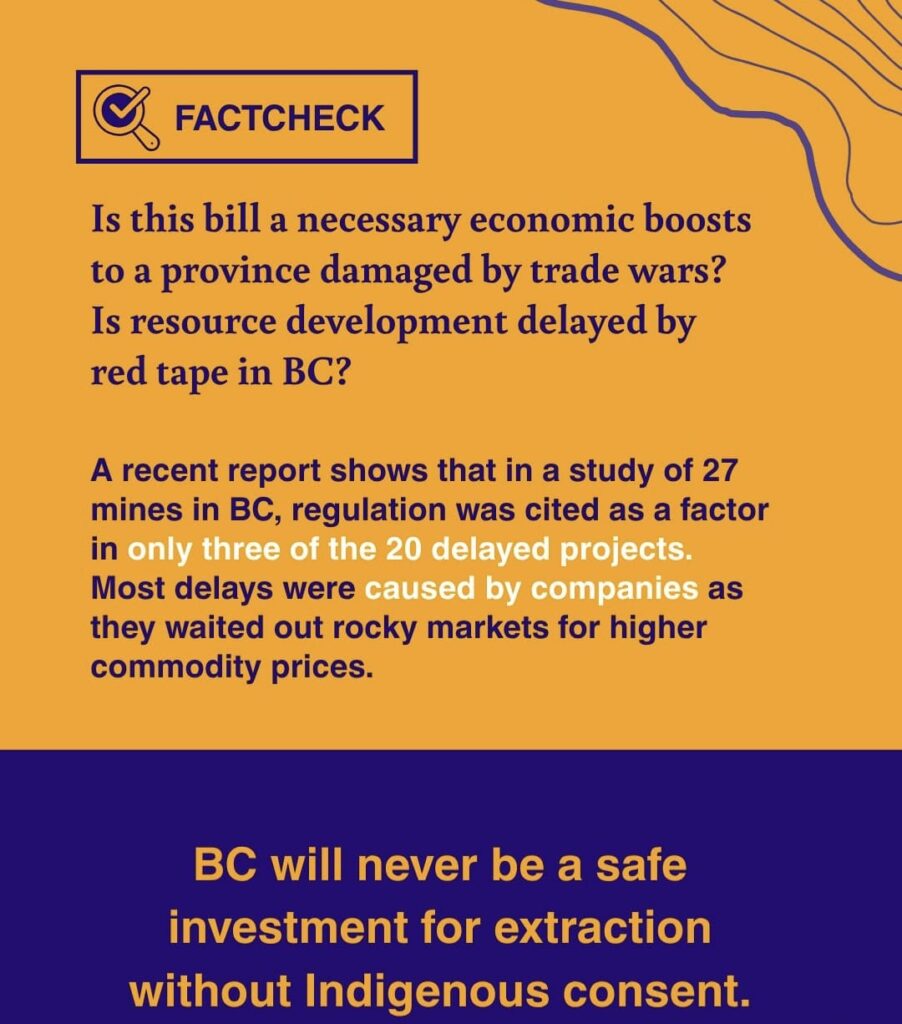
This begs the question: Is Bill 14 a necessary economic boost to a province damaged by trade wars? Is resource development delayed by red tape in BC? A recent report shows that in a study of 27 mines in BC, regulation was cited as a factor in only three of the 20 delayed projects. Mostly delays were caused by companies as they waited out rocky markets for higher commodity prices.
Like with Bill 15, several First Nations oppose the bill due to a lack of adherence to the United Nations Declaration on the Rights of Indigenous Peoples, which Canada passed in 2021. The First Nations Leadership Council is concerned that neither Bill 14 or Bill 15 have substantive language about gaining Indigenous consent prior to fast-tracking these types of resource development projects. Given that these projects will be exempt from environmental review and are apparently free to ignore Indigenous sovereignty over territory, they have a much higher potential to pollute Indigenous nations’ lands and lifeways.