UPDATE (October 2025): Bill 97 has been killed. In this excellent analysis, Vijay Kolinjivadi and Nicolas Renaud write about the grassroots resistance and alliance-building that helped usher in its demise:
“Seeing the destructive potential of the bill while it was still being drafted, groups of Innu, Abenaki and Anishinaabe land defenders joined the Nehirowisiw to form the MAMO Alliance. MAMO means “together” in the Nehirowisiw and Innu languages.”
“After the bill was introduced, the alliance erected tipis as symbols of resistance and solidarity and issued eviction notices to 11 logging companies operating without their consent. They established blockades on roads and organised protests.”
“Quebec’s civil society also sprang into action. Environmental groups, wildlife biologists, fish and game outfitters, industry labour unions and artists also voiced opposition. University students and social justice collectives in Montreal organised support for the blockades.”
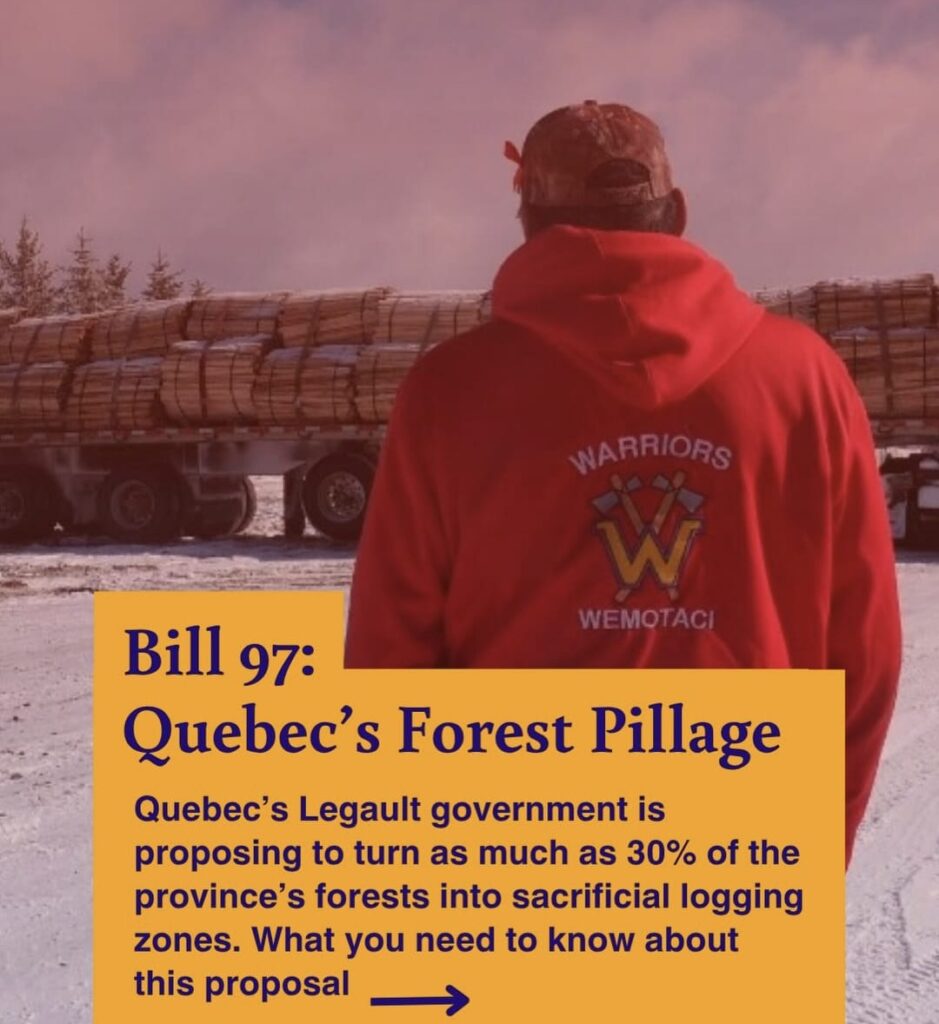
Bill 97, An Act Mainly to Modernize the Forest Regime, is the Legault government of Quebec’s proposal to open as much as 30 percent of the province’s forests up to industrial logging. The bill proposes to “divide” Quebec’s public forests into three different “zones,” one of which will grant extractive industry open access for development. Tabled by Quebec’s Minister of Natural Resources and Forest, Maïté Blanchette Vézina, on April 23, 2025, it is still subject to ongoing special consultations.
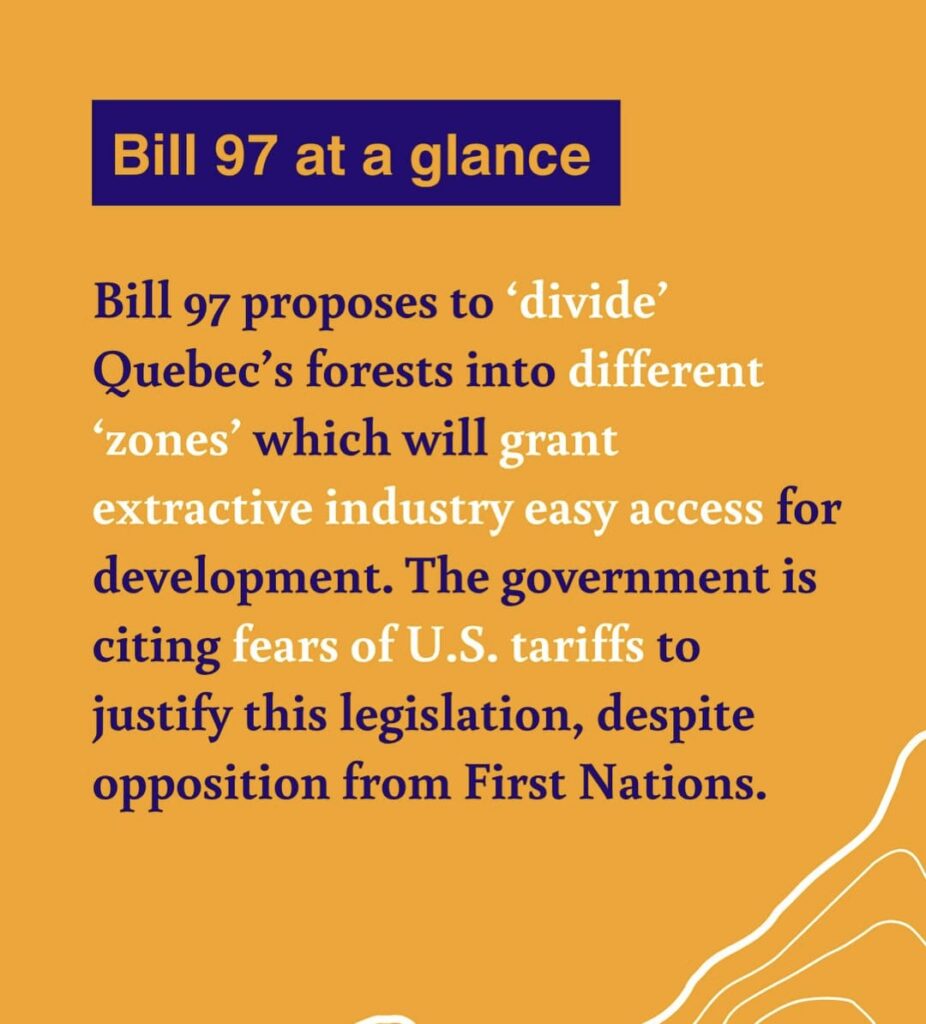
According to the bill, the “modernization” of the existing forest management will mean splitting the province’s forests into a triad of three zones: “priority forest development zones, conservation zones and multi-purpose zones.”
The first type of zone—priority forest development zones—will be dedicated to intensive timber harvesting, with the industry largely placed in charge of management. The designation of an area with this priority will lead to the prohibition of anything which gets in the way of logging, “effectively giving forestry companies an exclusive right-of-way.” Since nearly half of Quebec is forested, some 250,000 square kilometres could be opened to intensive logging.
The conservation zone designation refers to existing and future protected areas, where logging is currently restricted like in nature preserves. The final, multi-purpose zones may have elements of both development and conservation while also including space for tourism or “domestic, ritual, or social” activities of Indigenous peoples.
Once again, consultation with Indigenous peoples has been bypassed, and no economic livelihood or hunting rights are protected by the Act. Likewise, the bill amends the Sustainable Forest Development Act and provides sustainable forest development licenses to companies which would be issued for 10-year periods. These would replace the timber supply guarantees awarded to the industry which currently only last for five years, extending the lifespan of these licenses for pillage.
Blockades and protests have already happened in Innu, Nehirowisiw (Atikamekw), and Abenaki communities, who have formed a coalition called the MAMO alliance. They have sent eviction notices to 11 logging companies operating without consent.
Quebec is citing fears of U.S. tariffs, but they refuse to engage the title holders and have ignored opposition from First Nations. Labour unions have also spoken out against the bill, with Unifor arguing that this hurts their members’ jobs: “to make our jobs sustainable, we need a reliable timber supply and a new industrial strategy for the sector. On both counts, this bill misses the mark.”
The Assembly of First Nations Quebec-Labrador (AFNQL) is also opposed to the bill as recommendations of member nations were ignored in drafting the bill. Their concern is over the industrial privatization of their ancestral lands and the destruction of the development zones’ biodiversity.