By: Irina Ceric
In early February 2024, a Vancouver Palestine solidarity organizer called me with some burning questions.
“Is the Vancouver Port injunction from 2020 still valid?” she asked. “And can the police still use it to arrest people at a protest for an entirely different movement?”
Days before, she and other activists in British Columbia had successfully shut down two access points to the Port of Vancouver, pressuring the Canadian government to impose an arms embargo on Israel.
A few hours into the action, the police began threatening to arrest them. Organizers worried they would do so by resurrecting an old injunction—a court order directing people to do or not do things—issued four years earlier against Indigenous solidarity activists who had blocked the same port.
Organizers ended the action before anyone was arrested. But, she told me, organizers were planning another protest at a port south of Vancouver—so they needed to figure out whether the police could use the injunction, fast.
I had kept tabs on the web of injunctions that courts across Canada issued to shut down the #ShutDownCanada Wet’suwet’en solidarity movement in early 2020. When my organizer friend called me asking about whether the old port injunction could still be enforced, the best answer I could give her at that moment was “probably.” Getting a better one turned out to be surprisingly difficult.
Most injunctions, by definition, are meant to be temporary. Courts grant injunctions in order to prevent some kind of harm, while a lawsuit proceeds to resolve the underlying issue. But court orders restraining land defence and protest actions are remaining in place indefinitely—the result of a quiet understanding that no trial will, or was ever intended to, take place.
These are zombie injunctions, lingering court orders that continue to lurch around wreaking havoc. These zombies should have been killed off months or years earlier. But across Canada, they are giving law enforcement a powerful, shadowy tool to intimidate social movements.
‘A vague threat can still be an effective one’
Injunctions are often a legal means to an end.
Lawsuits filed by corporations or governments against activists or land defenders generally seek monetary damages, but the immediate goal is a court order shutting down the protest.
Injunctions give police the authority to remove and arrest people who are standing in the way of pipeline construction or a logging truck, and allow the project to continue. Although injunctions are only granted as part of a broader court action and are not meant to be final remedies, they do serve as a resolution of the actual “problem” driving the lawsuit—interference with resource extraction projects.
Once the injunction is issued, especially if the project then successfully goes ahead, there is little reason for governments and corporations to continue with the underlying legal action. They just don’t have a lot of incentives to move forward with costly, lengthy, and uncertain litigation against defendants who likely cannot afford to pay damages.
Another factor is that zombie injunctions are often issued against “John and Jane Doe,” meaning there may not be specific defendants responsible for knowing the lawsuit’s status. But even if one or more individuals are named in a court order, those people may not have the time or resources (especially the money to hire lawyers) to challenge the claim underlying an injunction that appears to have run its course.
Court orders left lurking in the wake of apparently abandoned lawsuits can cause confusion and uncertainty, chilling freedom of expression and assembly.
Zombie injunctions are an example of how seemingly neutral legal tools can be weaponized to strengthen and normalize the coercive power of already-powerful actors in perpetuity. The fact that Vancouver police did not actually enforce the injunction against Palestine solidarity protesters only underscores the problem: a vague threat can still be an effective one.
Exposing the undead
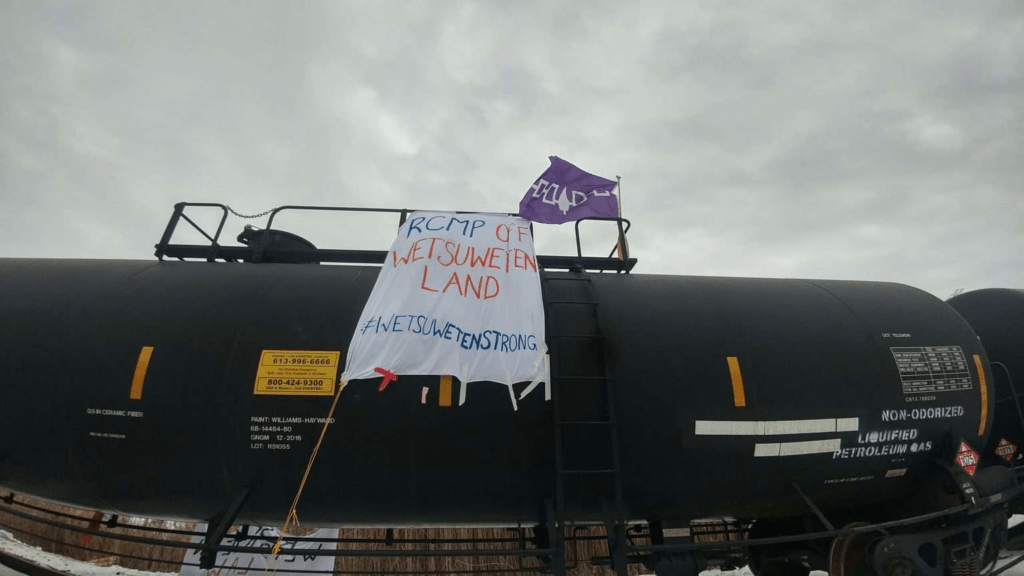
In the summer of 2024, Windsor University law student Emily Kydd and I attempted to track the status of 14 injunctions that had been issued to block or prevent Wet’suwet’en solidarity protests four years earlier. (This number does not include the original injunction order granted to the pipeline company Coastal GasLink in 2019 and enforced on Wet’suwet’en territory).
Seven of these injunctions were issued in B.C., three in Quebec, two in Ontario, and one in each of Alberta and Manitoba. Three injunctions were obtained by government entities (the B.C. Legislature, the Province of B.C., and the Attorney General of Quebec), while the remaining 11 were obtained by major infrastructure or transport-related private corporations and Crown corporations like B.C. Ferries and CN Rail.
After much digging, we determined that 12 of the 14 injunctions were likely still in effect. One interim injunction, issued for 10 days, had simply expired. Of the other, mostly interlocutory orders, in only one case—a CN Rail injunction obtained in B.C.—had a plaintiff filed a notice to discontinue the case.
As I wrote in a guide to injunctions for activists and land defenders: an interim injunction is issued on a temporary basis. An interlocutory injunction will stay in force until the lawsuit is completed, an application is made to dissolve the injunction, or the case is dismissed.
The other cases we could track had been left hanging, most with no activity at all after the court issued an injunction. None had proceeded to anything close to a trial.
Accessing this information was a slow and frustrating challenge, even for two people with legal training, time, and a research budget. While the court websites of some provinces now include databases of case information, there are often fees for viewing documents. Some websites only provide an overview of dates and events, with most documents only available in hard copy at a courthouse registry. Other provinces do not make any court filings information available online, meaning that phoning or visiting a court registry is the only way to figure out the status of a lawsuit or injunction. And of course, all of these methods require some familiarity with court processes.
How do you defeat a zombie?
While rules that govern lawsuits and injunctions vary from province to province, generally speaking, there are two ways to kill a zombie injunction.
First, you can move to terminate the underlying lawsuit. To do this, a defendant can bring a motion to dismiss a civil action based on the plaintiff’s failure to pursue the case—in other words, for not completing any of the steps necessary to bring it to trial in a timely way. There may be other grounds for dismissal, too, though this varies between provinces. A successful motion to dismiss brings the entire lawsuit to an end.
The second way is to apply to a court for an order dissolving an injunction on the basis of delay. In a case involving anti-logging protests in Clayoquot Sound, an injunction granted in 1991 was dissolved three years later because no steps had been taken in the underlying action. The court ruled that the injunction order should not be permitted to remain in place indefinitely and ordered that it be dissolved three months after the date of the decision.
More recently, when the logging company Teal Cedar Products Ltd. applied to the B.C. Supreme Court to extend its time-limited injunction against the Fairy Creek Flying Squad, whose activists had been blocking the company’s logging of old-growth forests, a judge refused to issue an extension that would keep the order in place until trial. The judge wrote that because Teal Cedar had “not yet moved the case forward in any appreciable degree,” he would grant only a one-year extension and that, if the company wanted any further extensions, it must return to court and “demonstrate that it remains just and equitable to leave in place the ‘drastic remedy’ of an interlocutory injunction.”
Right now, organizers haven’t pursued either of these two paths to kill the Port of Vancouver injunction or any of the other court orders against Wet’suwet’en solidarity protests. The zombies still lurk because killing them with existing tools would pull too many resources and too much attention away from more pressing priorities.
But we may soon have more zombies awakening. As the federal, Ontario, and B.C governments pass laws allowing resource extraction to be fast-tracked through Indigenous lands, resistance to these laws is building. That means police may decide to dust off old injunctions to crush new protests and blockades.
And it’s very hard to figure out if an injunction is alive, dead, or undead—until it bites you.
A version of this post was published by The Breach on January 19, 2026, titled “Police could use ‘zombie’ court orders to shut down social movements.”