Compiled by: Shiri Pasternak, with contributions from UVIC’s ELC Clinic students
Indigenous legal orders are different from Aboriginal law, which was created by Canadian courts and legislatures, and governs only the relationship between Indigenous peoples and the provincial and federal Crowns, within Canada’s colonial legal system.
1. Inherent Indigenous Rights and Injunctions
Indigenous Law in the Courts
According to Anishinaabe legal scholar John Borrows, Indigenous law has many sources, including sacred, natural, deliberative, positivistic, and customary. Rather than refer to a set of rules governed by state legislatures and the court system, Indigenous law represents a vast diversity of legal processes that correspond to Indigenous nations’ governing practices and principles. Indigenous legal orders are different from Aboriginal law, which was created by Canadian courts and legislatures, and governs only the relationship between Indigenous peoples and the provincial and federal Crowns, within Canada’s colonial legal system. Indigenous law represents the inherent rights and title of Indigenous nations.
Indigenous law is not normally codified, so recognition of these legal orders by outsiders relies heavily on translating its practices in the context of Indigenous life and its animating histories. As Val Napoleon writes, “Law is an intellectual process, not a thing, and it is something that people actually do. Indigenous peoples apply law to manage all aspects of political, economic, and social life including harvesting fish and game, accessing and distributing resources, managing lands and waters.” As a resource for social deliberation, Indigenous law has changed over time. Napoleon explains: “At its most basic level, law is collaborative problem solving and decision-making through public institutions with legal processes of reason and deliberation.”
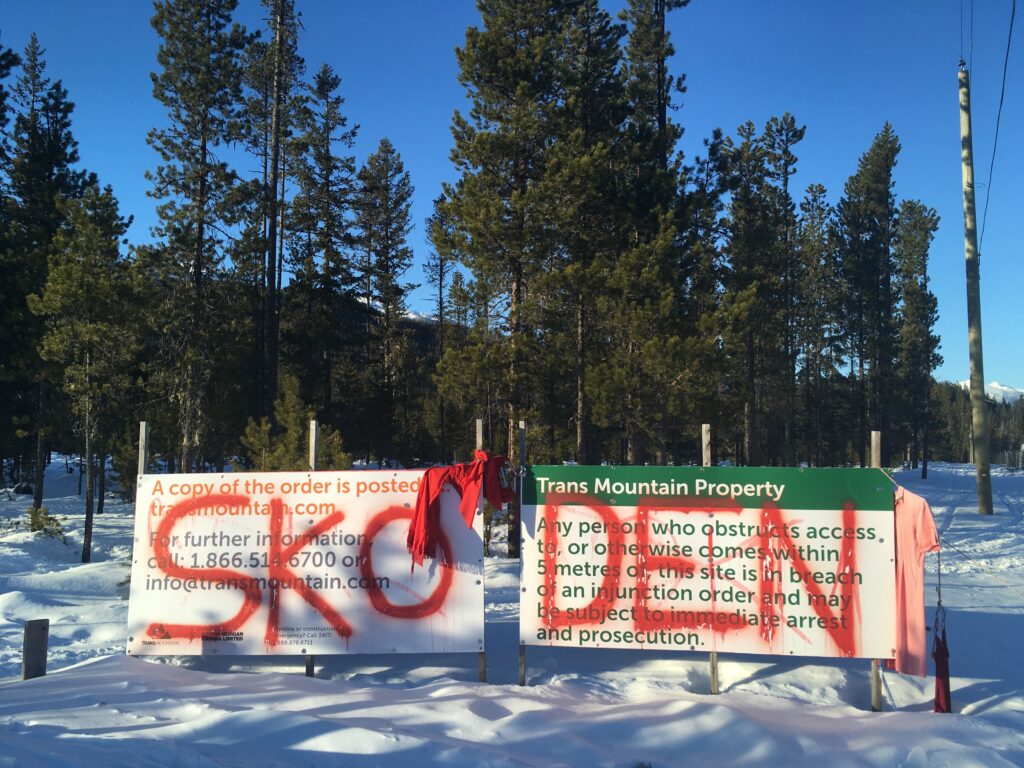
For example, the assertion of Indigenous law and jurisdiction at a blockade is almost always the legal effect of deep community consultation that engages questions of territorial responsibility and its enactment in the face of damage or destruction.
The extent to which Indigenous law is recognized by Canadian law has been a major issue that has been dealt with inconsistently over the past two decades. But in general, Canadian courts have increasingly accepted that Indigenous legal traditions and laws are real, valid, and exist regardless of whether or not all Canadian court cases have declared that to be the case.
That said, lighting the way to meaningful reconciliation between Indigenous law and Canadian law, many judges have recognized Indigenous law as part of Canada’s legal traditions. Justice Grammond summarized this state of affairs in Pastion v. Dene Tha’ First Nation, 2018 FC 648 at para 8:
Indigenous legal traditions are among Canada’s legal traditions. They form part of the law of the land. Chief Justice McLachlin of the Supreme Court of Canada wrote, more than fifteen years ago, that ‘aboriginal interests and customary laws were presumed to survive the assertion of sovereignty.’
Not only is Indigenous law a component of Canada’s legal plurality, as Kent McNeil argues, “the right to use Aboriginal law can also be regarded as a constitutionally protected Aboriginal right.” He and others point to key decisions concerning Indigenous law in the courts that support this view:
- In Campbell v. British Columbia (Attorney General), [2000] the court held that Aboriginal titleholders’ decision-making authority over their lands is inherent and governmental.
- A long line of family law cases have referenced Indigenous law , from Connolly v. Woolrich [1867] which recognized customary marriage, to Casimel v. Insurance Corp. of British Columbia which held that the Carrier people have a constitutional right to rely on their own customary adoption laws, to Manychief v. Poffenroth [1994] which recognized that Indigenous customary marriage had the same standing as marriages under provincial law.
- In Tsilhqot’in Nation v. British Columbia [2007] at para 470 the question of who the proper title holders are was answered by the court as “the community of Tsilhqot’in people.” These rights were based on the fact that the “Tsilhqot’in people were the historic community of people sharing language, customs, traditions, historical experience, territory and resources at the time of first contact [with Europeans] and at sovereignty assertion [by the Crown].” In other words, the inherent rights of the Tsilhqot’in people rested in their own legal traditions, not the Crown’s. This ruling of proper title holders was never challenged by the Crown when the case went up to the Supreme Court of Canada.
- Skyler Williams received an absolute discharge after being charged criminally in connection with his role blockading 1492 Land Back Lane. The judge stated: “Skyler Williams was carrying out his actions as a land protector in the context of these Haudenosaunee laws.”
Despite this rich tradition of recognition that Indigenous law is alive and has force against the imposition of Canadian law, many justices continue to refuse to accept its authority. For example, in Coastal GasLink Pipeline Ltd. v. Huson, Justice Church of the BC Supreme Court denied the place of Indigenous law as a recognized form of authority in Canada, stating:
As a general rule, Indigenous customary laws do not become an effectual part of Canadian common law or Canadian domestic law until there is some means or process by which the Indigenous customary law is recognized as being part of Canadian domestic law, either through incorporation into treaties, court declarations, such as Aboriginal title or rights jurisprudence, or statutory provision…. Indigenous laws may, however, be admissible as fact evidence of the Indigenous legal perspective, where there is admissible evidence of such Indigenous customary laws (emphasis added).
By denying the authority of Indigenous law, Justice Church rejected the Wet’suwt’en plaintiffs’ responsibility to their territory within their own governance system. In this case, as in many others, Wet’suwet’en responsibility to their territory contradicted provincial laws of regulation over resource extraction and development. Justice Church also erred in presuming that recognizing Indigenous law formally brings it into existence – it does not. Canadian courts cannot bring Indigenous law into force or create it; the whole point is that it precedes Canadian law as a practice.
This is the problem when a colonial system of law practiced by experts in a courtroom is empowered with the authority to recognize Indigenous law practiced in a context of social deliberation and governance. Justice Church’s decision on the Coastal GasLink injunction reflects two key longstanding issues which have largely criminalized and suppressed Indigenous legal traditions:
- A lack of understanding by the court on the meaning of Indigenous law, accompanied by an inability to adjudicate it.
- The hierarchical nature of the encounter between Indigenous peoples and the Canadian legal system, where settler courts hold interpretive authority over what constitutes Indigenous law and when and how it applies.
In many cases over decades, the courts have refused to recognize the self-determination of Indigenous communities and nations due to a restrictive, colonial, Eurocentric interpretation of Indigenous governance.

Photo Credit / Chief Dsta’hyl’s family
For instance, Chief Dsta’hyl, a Wet’suwet’en wing chief of the Likhts’amisyu Clan, was charged criminally in 2021 for decommissioning 10 pieces of Coastal GasLink’s heavy construction equipment in observance of Wet’suwet’en trespass laws on unceded Likhts’amisyu territory. Amnesty International called him “Canada’s first-ever ‘prisoner of conscience’”. Yet, Justice Tammen of the BC Supreme Court ruled Dsta’hyl is guilty of criminal contempt. Referring to the Wet’suwet’en law of trespass versus the Coastal GasLink injunction the chief violated, Tammen stated: “The two legal orders cannot comfortably co-exist in the circumstances.” Dinï ze’ Dsta’hyl is the highest ranking person to be charged for violating the CGL injunction. At his hearing, he argued that it was the injunction that was a violation of Wet’suwet’en law. Yet the hierarchy of laws predetermined the outcome of the case, despite the contested question of underlying title to the land. If the Wet’suwet’en hold underlying title, this presumably includes the right to govern their land, and exercise their law. The decision is currently under appeal.
2. Aboriginal Law and Injunctions
When disputes arise, courts tend to rely on provincial laws to deal with issues of Aboriginal rights and title and/or Indigenous inherent rights and territorial authority. This can invite jurisdictional conflict. Indigenous people fall under Section 91(24) of the Constitution Act, which places them under the federal head of power — not under provincial jurisdiction under the constitutional divisions of power. While the courts have accepted that provincial laws of general application can pertain to First Nations, and even infringe Aboriginal rights, when it comes to injunctions this brings to head a major problem within the law. It is the federal government of Canada that currently enters into treaty and title negotiations with Indigenous peoples, yet the federal Crown never appears as intervener in these cases – even when Indigenous treaty and title rights are at stake.
Let’s take, for example, British Columbia.
In BC, the Land Act asserts that the minister has administration of all “Crown land” except land specifically under the administration of another minister, branch or agency of government. This provision provides various provincial ministries the authority to issue permits to use Crown land, which is a source of revenue for the provincial government and an opportunity to secure employment for BC residents. But when Crown land itself is under dispute, where does this leave provincial authorization regimes?
As the lawyers in Chief Dsta’hyl’s case argued, successive chief justices of the BC Court of Appeal have recognized the need to develop and expand the common law to give substantive force to Indigenous legal orders. In a 2012 paper, Chief Justice Finch called on lawyers and judges to make space for Indigenous legal orders within existing Canadian legal frameworks. This task is daunting, but critically necessary. If courts decline to grapple with Indigenous legal issues, “this would be to evade the courts’ existing legal responsibilities, or worse still, to pay lip service to the principles involved while perpetrating a legal paradigm which has done little, thus far, to effect meaningful reconciliation between the Crown and Indigenous peoples in Canada.”
Finch C.J. instructed courts to take the Aboriginal perspective, and accordingly Aboriginal legal principles, into account in diverse areas of Canadian law, including criminal law. This legal obligation has strong roots in Supreme Court case law, and is not limited to s. 35 Aboriginal rights or title cases.
Aboriginal Title and Injunctions
Since injunctions are a unilateral action of court discretion, they are in direct contradiction to Canada’s commitment to achieving reconciliation and forming a nation-to-nation and government-to-government collaborative relationship. This is even more prominent where Indigenous nations have recognized title or are participating in negotiations regarding land title rights.
Certain features of an Injunction can cause significant harm to Aboriginal peoples, especially during ongoing title claims. For example:
- Injunctions eliminate and disregard free and informed prior consent, a requirement for recognized Aboriginal title.
- Injunctions are legally binding and thus failure to comply can lead to contempt of court regardless of one’s Aboriginal rights.
- Injunction enforcement occurs through the settler police force which may engage generational trauma.
- Arresting Indigenous people for contempt of injunctions may be a further deterrent to engaging in reconciliatory efforts with the government, as well as a deterrent to engaging in title negotiations.
- Injunctions can prohibit Aboriginal title rights including the right to hunt and fish on the land.
- Failure to uphold Injunctions by First Nations against commercial resource extraction can permanently harm and reduce accessible resources for Indigenous generations to come (who may in the future have recognized title over the land).
First Nations face significant harms when subjected to injunctions particularly where their rights and title are constrained by the narrow framework of “irreparable harm”. Irreparable harm is at the core of injunctive relief since it is precisely what entitles litigants to the extraordinary and discretionary relief of injunctions: an immediate stopgap mechanism without trial. The plaintiff must show immediate harm that cannot await resolution at trial or be addressed any other way, especially through damages.
The natural resource economy is of central importance to Canada’s political economy and it tends to determine “public interest” arguments around what is the greater case for “irreparable harm” — is it to local companies and workers, subject to boom and bust resource economies, who might lose money or workers who might lose jobs? Or to First Nations who risk their own economic, spiritual, legal, and cultural survival if the source of their natural wealth deteriorates further?
Take for example a precedent-setting case in 1989, Westar Timber Ltd v Ryan et al. This case involved the Gitksan Nation’s conflict with a forestry company that sought to log and expand operations into a region over which the Nation was asserting title as part of the Delgamuukw case. Esson JA found that “the court should not grant an injunction if the economic consequences of doing so would have a serious impact upon the economic health of the province, the region or the logging company.” Thus, the public interest argument here smothers the possibility of challenging provincial regulation that may constitute irreparable harm to Indigenous rights.
As Esson JA argued:
…injunctions restraining the exercise of rights granted under the Forest Act could sterilize the working of that statutory scheme just as effectively as injunctions restraining the granting of licenses and other rights, that being so, the public interest must be considered in applications of this kind.
In other words, Canada’s natural resource economy has two crises: first, its internal contradictions of boom and bust cycles of production, coupled with the natural limits of supply; and second, insecure land tenure for investment in resources on lands where Indigenous peoples challenge the Crown’s claim to underlying title and rights. In injunction cases, the courts only tend to deal with the former crisis because it fits a temporal and racial understanding of economic duress. So they grant corporations leeway to argue that their survival trumps other considerations. Racism against First Nations makes quick work of the second problem. For more on this, see Pasternak and Ceric.
To address these harms in an effective way, courts should not issue injunctions that negatively affect Indigenous communities where title rights and negotiations are ongoing. Instead, courts should act to utilize injunctions as a tool of protection to prevent harm to land and resources while these negotiations are ongoing.
While there is a perception of a willingness to work with Indigenous nations regarding land policy, there are barriers to the actualization of this goal. One of these barriers is the implementation of injunctions against Indigenous communities. Another barrier is the challenges with pursuing an Aboriginal title claim, which can take dozens of years and cost millions of dollars. Finally, the main barrier is that “title” itself is the colonial state’s recognition of what is already title, subjecting First Nations to endless legal processes and criminalization to avoid this reality. Similarly, failures to recognize the spirit of the treaties leads to the same impasse. Regardless of Indigenous people’s inherent rights, the federal and provincial governments continue to present roadblocks that limit First Nation exercises of jurisdiction over land.
3. Consultation and Injunctions
The duty to consult is a legal precedent that addresses the potential infringement of Aboriginal and treaty rights and is protected by s. 35 of the Constitution Act, 1982, which recognizes and affirms existing Aboriginal and treaty rights. It has a long history of intersection with injunctions filed by and against Indigenous peoples to protect their lands.
First, what is the duty to consult and when is it supposed to happen?
- The Duty to Consult & Accommodate is a doctrine of settler law. It is a constitutional obligation that arises from section 35 of the Canadian Constitution. It ensures that Indigenous peoples are meaningfully involved when government actions may affect their rights. This duty is owed to First Nations, not individuals.
- The duty applies even before Indigenous rights or title are legally proven. The duty is triggered when the Crown has knowledge of a potential or established Indigenous right that could be negatively impacted. It also applies during early planning stages of projects.
The courts have said that consultation must be timely, clear, and directed to the right communities. Indigenous groups must be given enough time and information to understand and respond to proposed actions. The process must be transparent and consistent. The courts have also said that meaningful consultation is a two-way dialogue. It is not enough to simply gather concerns; the Crown must genuinely listen and respond. The process must be open to the possibility of changing plans to accommodate Indigenous interests.
This precedent was set for Indigenous nations with Aboriginal title assertions in the Haida decision in 2004. Haida said that Aboriginal rights must be protected even in the pre-proof stage of assertion: this was the Crown’s duty to consult and accommodate. In Haida, the Supreme Court of Canada advised that First Nations should rely on their s. 35 protected rights to consultation, rather than pursuing injunctions, because the duty to consult would better safeguard their interests.
Reasoning the need for this legal shift, the Court laid out four limitations of injunctions:
- First, they may not capture the full range of government obligations;
- Second, the duty to consult necessarily entails balancing interests and thus could go further towards reconciliation;
- Third, the balance of convenience test favours industry and jobs, prejudicing the courts against First Nations before the merits can be determined; and
- Fourth, stopgap measures like injunctions should not be used for complex matters, which must be given adequate time in courts to resolve.
But this warning backfired when — out of necessity — First Nations sought urgent relief or were faced with plaintiffs seeking to remove them from their lands. Judges then interpret Haida to reason that First Nation cases should be heard in different proceedings, in litigation over rights or title, or else attempt to adjudicate their rights and title on the merits based on scant evidence. So their efforts to obtain injunctions may be denied, or to assert their rights in the face of injunctions obtained against them may be denied on this basis, as well.
The paradox that results is that the denial of injunctive relief to First Nations and the success of corporations and governments seeking injunctive relief against them practically constitutes a de facto resolution of disputed land claims. Put simply, the s. 35 duty to consult, alongside the long delays and evidentiary hurdles standing in the way of establishing Aboriginal rights and title more generally has proven to mostly work against First Nations seeking injunctive relief.
Is the duty to consult a good alternative to injunctions?
Crown consultation with First Nations satisfies the Crown’s duty, but the extent (or level) of the Crown’s obligation to consult will vary depending on the nature and scope of the Aboriginal interests impacted.Further, the Crown is under no obligation to reach an agreement. Instead, the commitment only extends to good faith and varies on a case-by-case basis. The Crown must balance Aboriginal concerns with the potential impacts on rights or title with other societal interests.
The duty to consult also applies to treaty nations, as decided in Mikisew Cree Nation v. Canada (2005). The Supreme Court decided in that case that treaty rights, like the government’s right to take up lands, are subject to the duty to consult, alongside other treaty rights like hunting, fishing, and trapping. If appropriate, accommodation must also be forthcoming.
Note that the duty to consult and accommodate only applies to the government, not corporations and other third parties. Although not required by law, there has been a positive trend in state recognition of Indigenous jurisdiction and requiring that federal or provincial governments obtain free, prior, and informed from nations before approval of activities. A duty to consult also does not mean consent. The difference in the approaches required by law (consultation), and those laid out in UNDRIP and DRIPA (free, prior, and informed consent) leads to a perpetuating failure to protect Indigenous interests in land and ultimately contributes to tensions between government, industry, and Indigenous communities. Others oppose the method of consultation as being limited, under tight timelines and not permitting a community process.
Another problem with the duty to consult is that the depth of consultation depends on the situation and the “strength of claim.” At the high end of the spectrum, Indigenous peoples have strong prima facie evidence of their underlying title or treaty rights, established through extensive research, documentation, land use mapping, and oral history. On the lower end of the spectrum, Indigenous peoples have not been able to access resources to undertake this documentation. Over time, these legal thresholds were set that determine how well Indigenous peoples met the tests for establishing their land claims. According to the courts, this work includes establishing evidence of long use and occupation in one place and continuous practices mostly unbroken from old pre-contact ways, and an ongoing use of traditional lands and dependence on those old ways for current governance and cultural practices. Some scholars call these evidentiary burdens a requirement to prove their “frozen rights” that lock them into a rigid, unchanging past.
And what does it take to prove all this? It requires huge amounts of money to make maps and produce this research up to the court’s legal and ethnographic standards. So even if a First Nation has all this knowledge, if they’ve never professionally recorded it, they can’t prove it in court.
For communities who land at the lower end of the consultation spectrum, the Crown must provide notice, share information, and listen to concerns. It must act in good faith and try to reduce any negative effects. This level applies when claims are weak or impacts are minor. In midrange cases – they have some proof of claim – the Crown must go further by considering the involvement of Indigenous communities in decision-making. It should explain its actions and reasons clearly. This level applies when there is a moderate impact or moderately strong claim. At the upper end, the Crown may need to reconsider or even cancel a project. It must seriously consider Indigenous concerns and explain any decisions that go against expert advice. Written reasons and a willingness to change course are essential.
Very few nations have successfully proven Aboriginal Title in Canadian courts, all of them in BC. The Tsilhqot’in were the first, but the landmark 2014 SCC decision awarding them title to part of their traditional territories took tens of millions of dollars and over a decade in the courts. Another BC nation, the Nuchatlaht, was awarded title to a small portion of its coastal territory off Vancouver Island in 2024, although their appeal of this decision is currently pending. Most recently, the BC Supreme Court awarded title to the Cowichan Tribes group of nations to about half of the territory claimed, including to lands in greater Vancouver owned in fee simple by municipal and federal governments. This was the first time that a Canadian court had held that some Crown grants of land to settlers did not extinguish Aboriginal title, precipitating a wave of misinformation and racist fearmongering about private property rights.
These three decisions rested on the SCC’s 1997 decision in Delgamuukw, when two other nations – the Wet’suwet’en and the Gitxsan – successfully proved that BC and Canada had never extinguished their title. Although the case established Aboriginal Title as a constitutional right, the nations’ claims were sent back to a trial court after the SCC held that the trial judge had wrongfully rejected oral history. Finally, the Haida Recognition Act passed into law in April 2024, affirming that BC recognizes and that the Haida Nation holds Aboriginal title over the island of Haida Gwaii, the nation’s homelands.
A last point is that consultation with governments often takes place with leadership elected under the Indian Act system. While some Band Councils respect the will of their people and act on a consensus model, many Indigenous peoples do not acknowledge that elected leadership has the authority to make decisions about territory, which may be the responsibility of customary or hereditary leadership. Hereditary leadership, for example, is based on a governance structure that maintains continuity with the governance systems some nations practiced prior to the imposition of Band Councils by the federal government. These systems tend to be reversed in structure: the people hold the power and their will is carried out by designated leaders.
4. UNDRIP and Injunctions
What is the United Nations Declaration on the Rights of Indigenous Peoples?
The United Nations Declaration on the Rights of Indigenous Peoples (the “Declaration” or “UNDRIP”) is an international human rights instrument that describes the rights of Indigenous peoples around the world. UNDRIP is a declaration that recognizes Indigenous peoples’ unique position within states and provides them special protections related to their “Indigenous identities, livelihoods, and ways of knowing and being in the world.”
Many provisions of the Declaration relate directly to Indigenous land defence rights by upholding the autonomy of Indigenous peoples. Specifically, the declaration requires Indigenous peoples’requiring their free and informed consent to projects affecting their lands, and affirms the right to occupy and regulate their lands as they desire. Relevant provisions include:
- Article 3
- Indigenous peoples have the right to self-determination. By virtue of that right they freely determine their political status and freely pursue their economic, social and cultural development.
- Article 10
- Indigenous peoples shall not be forcibly removed from their lands or territories. No relocation shall take place without the free, prior and informed consent of the Indigenous peoples concerned and after agreement on just and fair compensation and, where possible, with the option of return.
- Article 18
- Indigenous peoples have the right to participate in decision-making in matters which would affect their rights, through representatives chosen by themselves in accordance with their own procedures, as well as to maintain and develop their own indigenous decision-making institutions.
- Article 19
- States shall consult and cooperate in good faith with the indigenous peoples concerned through their own representative institutions in order to obtain their free, prior and informed consent before adopting and implementing legislative or administrative measures that may affect them.
- Article 32
- 1. Indigenous peoples have the right to determine and develop priorities and strategies for the development or use of their lands or territories and other resources.
- Article 37
- 1. Indigenous peoples have the right to the recognition, observance and enforcement of treaties, agreements and other constructive arrangements concluded with States or their successors and to have States honour and respect such treaties, agreements and other constructive arrangements.
Does UNDRIP apply in Canada?
Canada voted against ratifying the UNDRIP in 2007 when it was introduced in the UN General Assembly. In 2016, Canada removed its objector status from the declaration and pledged its “unqualified support.” Minister of Indigenous Affairs, Carolyn Bennett stated:
Through Section 35 of its Constitution, Canada has a robust framework for the protection of Indigenous rights. By adopting and implementing the declaration, we are excited that we are breathing life into Section 35 and recognizing it as a full box of rights for Indigenous Peoples in Canada.
UNDRIP as a declaration does not have the same enforceability mechanisms as United Nations human rights conventions. Conventions are treaties, binding on state parties who ratify them. For example, Canada signed on to the UN Convention on Racial Discrimination in 1966, and has obligations for compliance. Canada must regularly report to CERD and respond to submissions brought by parties alleging violations of the convention.
UNDRIP is not legally binding in Canada. But Canada and the province of British Columbia did commit to implementing UNDRIP in Canada. Rather than adopt the articles of UNDRIP, however, both Canada and BC instead adopted UNDRIP principles into domestic law through their own legal interpretations of these principles.
Both the federal and provincial governments have stated that UNDRIP legislation will be interpreted in line with Section 35 of the Constitution. This means that domestic legal precedents will be paramount over international principles. While this may protect Aboriginal and treaty rights in some cases, it also may narrow the realm of possibility from what was imagined through UNDRIP. The difficulty here is that there are few legal precedents that recognize Indigenous consent without significant allowance for infringement of these rights. This is precisely why Indigenous peoples advocated internationally for recognition of their right to Free Prior Informed Consent (FPIC).
In June 2021, Canada passed the United Declarations on the Rights of Indigenous Peoples Act (“UNDRIP Act”). The stated purpose of the federal law is to “affirm the Declaration as an international human rights instrument that can help interpret and apply Canadian law. It also provides a framework to advance implementation of the Declaration at the federal Level.” Significantly, the UNDRIP Act does not codify UNDRIP into Canadian law. What the UNDRIP Act does is establish a process for making federal laws consistent with UNDRIP.
This process for making Canada compliant with UNDRIP involves an Action Plan outlining measures. They have so far released a draft action plan in March 2023 and release annual update reports. So far no legislation that does not directly pertain to internal Indigenous issues and governance have been amended. In contrast, in 2025 a flood of new federal and provincial legislation are being passed and pending that directly contravene Indigenous rights.
What the UNDRIP Act does not do is make UNDRIP paramount to Canadian law. It does not make the international legal principles that the Declaration enshrines superior to Canadian law. UNDRIP principles are not redefining Canadian law, but rather applied to Canadian law.
The Province of British Columbia passed the Declaration on the Rights of Indigenous Peoples Act (DRIPA) into law in November 2019. DRIPA adopts all the articles of the Declaration and commits to a process of reconciling BC law with these international legal principles. Section 3 of DRIPA states that: “In consultation and cooperation with the Indigenous peoples in British Columbia, the government must take all measures necessary to ensure the laws of British Columbia are consistent with the Declaration.”
In late 2025, in a challenge to BC’s gold-rush era “free entry” mineral tenure system by the Gitxaała Nation and Ehattesaht First Nation, a majority of the BC Court of Appeal ruled that DRIPA does incorporate UNDRIP into BC’s law, making the Declaration “justiciable” (enforceable in a court). The Court held that the Crown has a statutory duty to consult and cooperate with Indigenous peoples to address inconsistencies between rights and standards in UNDRIP and the laws of BC and issued a declaration that BC’s mineral claims regime is inconsistent with article 32(2) of UNDRIP.
Are injunctions consistent with the Declaration?
Since injunctions are court-ordered authority to prohibit a person or groups of people from doing certain things they are considered “law” and therefore subject to the UNDRIP Act and DRIPA.
As Shiri Pasternak writes, while DRIPA recognizes Indigenous peoples’ right to FPIC, are there currently any protections in the legislation that could mitigate the alarming rates of success corporations and provinces have had in using the injunction mechanism to remove title holders from their lands? Could DRIPA be used in court by Indigenous peoples to support their case against injunctions? Or would the province need to legislate these changes to the common law to align it with DRIPA? It is worth noting that injunctions tend to be filed in response to First Nation individuals and groups using their bodies to say no to a proposed development.
At least one clear avenue for legislative reform exists to align BC law with UNDRIP as is called for by the Act. BC should pass legislation and/or amend current civil procedure statutes to amend the common law of injunctions and contempt as they apply to First Nations and other Indigenous groups. As Yellowhead Institute’s research has shown, injunctions serve to bypass not only Aboriginal rights enshrined in Canadian law, but are fundamentally incompatible with UNDRIP. Simply put, BC’s legal framework cannot and will not align with UNDRIP until the operation of injunctions as a tool of dispossession and criminalization is explicitly addressed.
For example, the injunction that Coastal GasLink (CGL) sought against the Wet’suwet’en was required because the hereditary leadership of the Wet’suwet’en Nation did not consent to the natural gas project. Their lack of consent was clearly communicated to the province of BC during the provincial environmental assessment process, where they stated:
Considering the magnitude of cumulative environmental effects on Wet’suwet’en territory and the lack of recovery plans or strategies to address those effects, and as well, the lack of Crown – Wet’suwet’en title, rights, and interests reconciliation, the Wet’suwet’en and the Office of the Wet’suwet’en protests and rejects the Coastal GasLink concept and Application.
Provincial authorization is where the violation of consent began, and what legitimated CGL’s lawsuit against those who were forced to express this dissent through blockades when all formal channels failed.
While domestic UNDRIP legislation claims to prioritize indigenous rights, the court system simply makes Indigenous rights consideration among many. As a result, injunctions can severely inhibit the internationally protected rights of Indigenous peoples when they are undertaking land defence activities.
Specifically, Article 10 of UNDRIP specifies that Indigenous peoples should not be forcibly removed from their lands or territories and that no relocation shall happen without free, prior, and informed consent. Article 32 states that the government shall consult and obtain free and informed consent from Indigenous groups before approving any project affecting their lands or territories and other resources, particularly in connection with the development, utilization or exploitation of mineral, water or other resources.
Conclusion
While courts have, at least superficially, affirmed their desire to uphold Indigenous rights, their commitment to the Declaration has fallen short in many court proceedings. As a result, unilateral state-issued actions such as injunctions are granted contrary to the input of Indigenous communities. Until our legal system takes a stricter approach to upholding Indigenous rights as set out in the Declaration and the inherent jurisdiction of Indigenous nations, little recourse is available to challenge these actions.