By: Irina Ceric
This resource explains what injunctions are, how and why they are issued, and what happens if people are charged with violating one. It is based on Canadian state law and contains general legal information only – it is not legal advice. If you have questions or concerns about your particular circumstances, get specific legal advice from a lawyer in your province.
What is an injunction?
An injunction is a legal remedy granted by a court to prevent interference with the legal rights of one or more people, a corporation, and/or a government. It is an order issued by a judge of a provincial superior court (e.g. the BC Supreme Court or the Manitoba Court of King’s Bench) after an application is filed as part of a lawsuit. The order is meant to protect the interests of the injunction holder while the lawsuit is pending, usually by requiring certain people to refrain from doing certain things. Mandatory injunctions, which require positive actions (e.g. stopping a construction project or pausing sales of a product), are also possible but are less common.
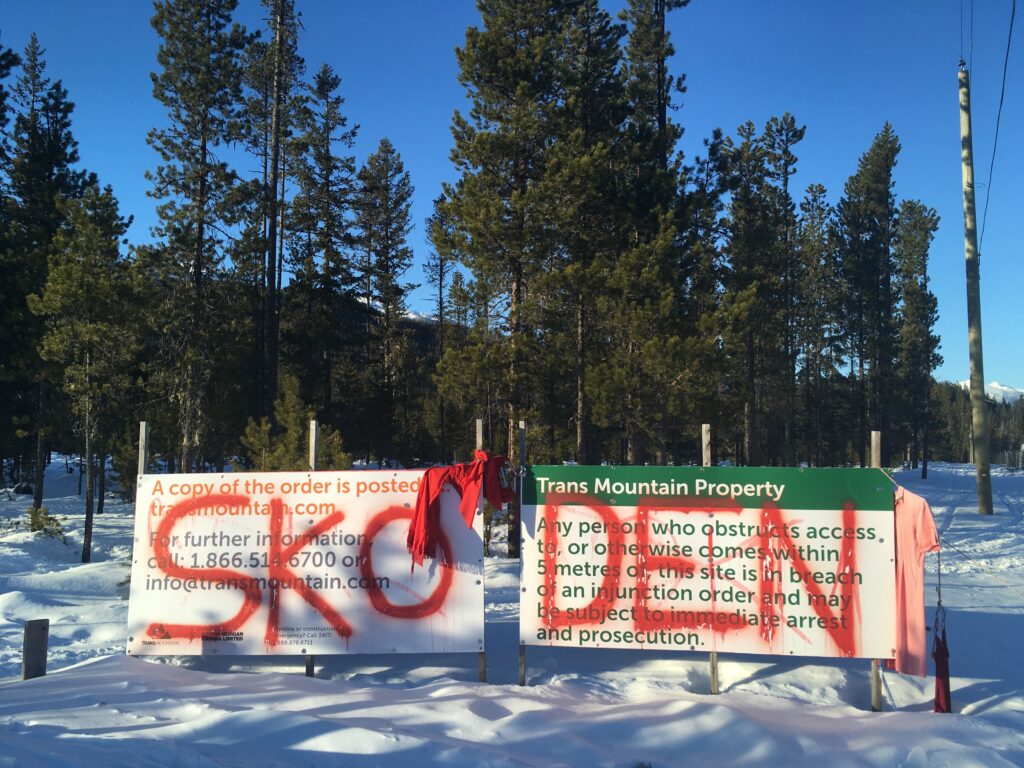
One of the most frequent uses of injunctions is to prohibit land defenders and/or protesters from interfering with permitted resource extraction projects. For example, the proponent of the Trans Mountain pipeline expansion project obtained an injunction to prevent people from obstructing or impeding access to the company’s work sites throughout BC.
How and why does an injunction get issued?
Before an injunction is issued, a judge reviews the application (which often includes affidavits and other evidence about the activities/events in question) and holds a hearing. If the matter is urgent, the hearing can be held ex parte, meaning that the defendants are not present in court (or on the call/video if the hearing is held virtually). The court is supposed to consider whether granting an injunction would be “just and equitable” given all the circumstances of the case. Three elements must be proven by the party seeking the injunction:
- That there is a serious legal issue to be tried in the underlying lawsuit (even if it will never go to trial – see the discussion of zombie injunctions)
- That the applicant will suffer “irreparable harm” if the injunction is not granted (usually, this means damage that cannot be financially compensated later on)
- That the “balance of convenience” favours issuing the injunction (in other words, the court asks which side would suffer more harm if the injunction was granted or refused)
Many injunction cases turn on this third element. Canadian courts have consistently held that Indigenous legal orders do not displace the application of settler law, meaning that First Nations who choose not to advance claims to right or title via colonial courts are at a disadvantage in the balance of convenience calculus. Judges routinely label blockades and other land defence tactics as illegitimate ‘self-help remedies’ despite the persistent failure of regulatory processes to meaningfully incorporate rights to free, prior, and informed consent on Indigenous territories. For example, the court in the Coastal GasLink injunction application found that land defenders had “no legal right” to blockade access to the pipeline as a factor affecting the balance of convenience.
How long can an injunction remain in place?
An injunction can be issued on an interim (temporary) basis or it can be interlocutory, meaning that it will stay in force until the lawsuit is completed or an application is made to dissolve the injunction and/or dismiss the case (see also: our explanation of “zombie” injunctions). Injunctions can also be made permanent after a trial or full hearing.
What happens after an injunction is issued?
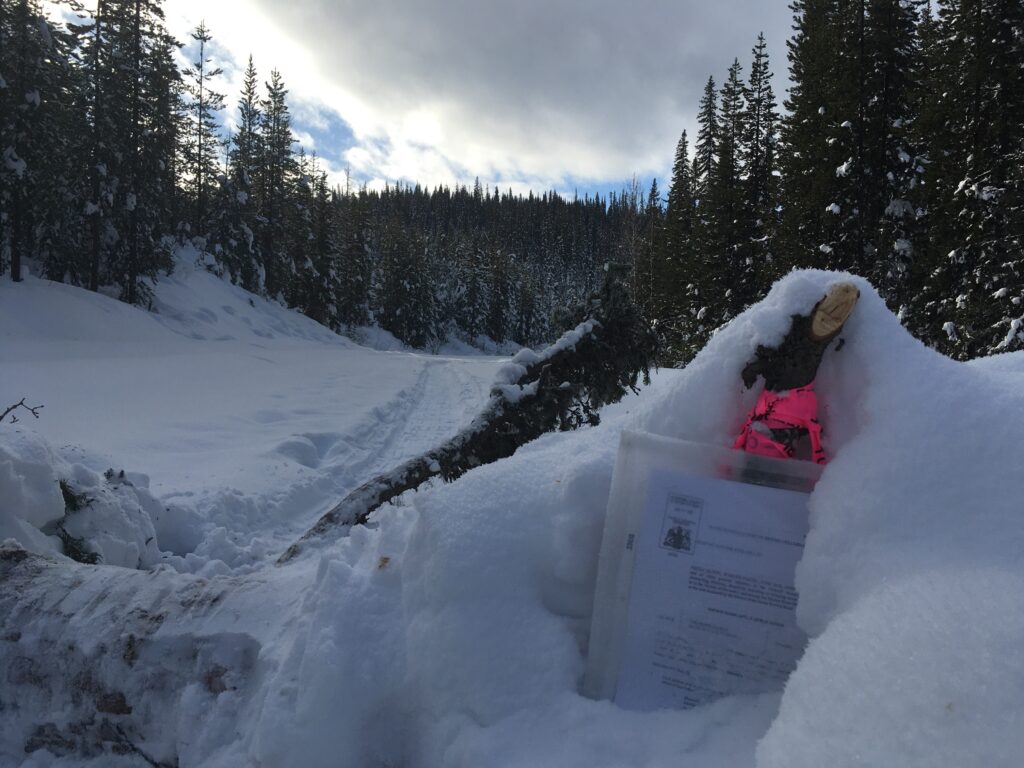
The party that sought the injunction must make sure that people subject to the court order know that it exists and what it says. The injunction holder may be required to post signs, hand out copies, share the order online, and/or have the injunction read out at the enforcement site. Injunctions are commonly issued against named defendants as well as “John Doe, Jane Doe and Persons Unknown.” This means that anyone – not just the named defendants – who is made aware of that injunction is required to obey it. The use of John/Jane Doe injunctions in the protest context was introduced by BC courts in the 1990s, a development spurred by injunctions obtained by forestry companies hoping to shut down massive civil disobedience actions in opposition to old-growth logging in Clayoquot Sound.
John/Jane Doe injunctions create disproportionate effects on Indigenous peoples by prohibiting all people from interacting with a defined place. In effect, the injunction severs Indigenous peoples’ ability to enact their responsibility to a specific place and undertake activities within the territory they rely on for their cultural, economic, and social expression. For example, hunting and fishing rights can be impeded by general restrictions to areas where work is taking place.
—Law students in the Environmental Law Centre (ELC) Clinic at the University of Victoria
If the injunction does not include an enforcement order, the police will seek one from the court. This order gives them the power to enforce the injunction by arresting anyone who has allegedly violated it. Enforcement orders sometimes require that police give people an opportunity to leave the area or otherwise comply with the injunction before they are taken into custody. If arrested, you should be told what charge(s) you’re facing and that you have the right to get advice from a lawyer.
People arrested for violating an injunction face two possible charges: contempt of court or the criminal offence of disobeying a court order. In either scenario, solidarity is key: work together to support each other and your movements, to fundraise for legal and other costs, and to keep the focus on organizing.
NOTE: Contempt of court charges are especially common in BC, where a provincial policy on civil disobedience discourages the use of criminal charges. While the general principles of contempt law apply across Canada, some practices and processes are unique to BC. Some of these are flagged below and more detail is available in the British Columbia Civil Liberties Association’s Injunctions and Contempt of Court guide.
What is contempt of court?
Because an injunction is an order of the court, a person who deliberately violates the terms of an injunction may be found guilty of contempt of court. Contempt of court is an ancient common law (judge made) offence that is not found in the Criminal Code – in fact, it is the last remaining common law criminal offence that is still permitted under Canadian law.
There are two kinds of contempt – civil and criminal – and both are meant to punish “willful” and/or “deliberate” behavior that interferes with the administration of justice. Because contempt charges arise out of a court order issued as part of a private lawsuit, civil contempt charges are generally prosecuted by lawyers hired by the injunction holder, not government Crown Attorneys (this may be different for criminal contempt; see below).
A conviction for civil contempt requires proof beyond a reasonable doubt of the following four elements:
- The existence of a valid injunction prohibiting the alleged actions
- That the accused breached one or more terms of that injunction
- That the accused is the person who breached the injunction (identification)
- That the accused had knowledge of the injunction
For contempt to be considered criminal, there must also be conduct amounting to “public defiance” which demonstrates “scorn” or “contempt” for the justice system. A criminal contempt conviction requires proof beyond a reasonable doubt of two additional elements:
- The accused’s conduct was public, continuous, and showed disregard for the court order
- The accused had intent or knowledge that “public disobedience” tends to depreciate respect for court orders
In BC, civil contempt charges can be converted to criminal contempt at any point in the process. The practice is for the injunction holder to request that the government take over the prosecution; if the request is granted, Crown Attorneys will step in and take over the case from the private lawyers.
The following are examples of activities treated as contempt of court:
1. Forming blockades to prevent the resource company access to an area, like a road, bridge, or worksite;
2. Digging deep trenches in roads, making roads dangerous to access;
3. Land defenders locking themselves at the bottom of trenches, placing themselves and RCMP officers at risk of injury if trench walls fall down;
4. Land defenders chaining themselves into “sleeping dragon” devices reinforced by metal hazards, barbed wires, or spikes. These devices are secured in the ground and used to hinder efforts of removing protestors on the roads;
5. Building barricades to prevent road access;
6. Placing objects on helicopter landing pads;
7. Land defenders hanging themselves over roads and bridges using tripods with railroad spikes and chicken wires, placing nooses around necks, locking themselves to tripods facing nails, and pouring urine down from atop the tripods;
8. Occupying “tree sits” by building shelters high in trees and sitting with barbed wire or metal structures at the bottom of trees.(list prepared by Law students in the Environmental Law Centre (ELC) Clinic at the University of Victoria)
What happens if I am charged with contempt of court?
Contempt charges are tried in front of a superior court judge using a summary process. While there is no right to a jury trial for contempt, accused do have the right to call witnesses and give evidence, present a defence, make submissions about sentencing, and as noted above, to have the charges against them proven beyond a reasonable doubt.
However, the right to present a defence does not mean that there are many good defences available. Accused have successfully proved lack of identification or demonstrated that they did not actually violate a term of the injunction (sometimes alongside arguing that the term itself wasn’t clear enough). More principled defences such as necessity (e.g. arguing that the climate crisis makes taking action against fossil fuel extraction necessary) or duress (arguing that you had no choice but to violate a court order to prevent other harm) have not proven successful.
Similarly, the court will not hear defences based on the validity of the court order, the underlying lawsuit, and/or the project in question or how it was permitted/approved. As lawyer Neil Chantler explained to the BCCLA, “It is a well-established principle of law that you can’t attack the legitimacy of the injunction you are alleged to have breached. You cannot argue issues of entitlement to the land, for example. Those arguments had to be made at the time the injunction was granted, or in a subsequent application to quash the injunction. To argue the injunction was improperly granted is called a ‘collateral attack’.”
In BC, some people charged with contempt have successfully obtained legal aid funding to pay for lawyers, but the availability of legal aid funding varies from province to province and is often not available to accused not facing a serious risk of jail time if convicted.
What happens if I am found guilty of contempt?
The possible penalties if found guilty of criminal or civil contempt are the same: fines, restitution orders, jail or house arrest, and/or community service. Sentences for contempt arising out of civil disobedience and land defence have ranged from a few hundred dollars in fines to jail terms of 6 months or more. In the Trans Mountain pipeline cases, the Crown sought a fine of $500 with no jail time for those arrested in the early weeks of a months-long civil disobedience campaign but escalated its sentencing position to a higher fine and jail time for those arrested later or more than once.
Contempt convictions do not result in a criminal record because they are not offences under the Criminal Code but they may be reported in other police databases and could be disclosed through record checks for employment or volunteer purposes. Note that rules and practices about these sorts of record checks vary between provinces and police forces and you should speak to a local lawyer if this is a concern. Broad questions about previous charges or arrests posed at the border can also wind up revealing contempt convictions, potentially impacting your ability to travel to the US.
What happens if I am charged with a criminal offence?
Especially outside of BC, alleged violations of an injunction may result in charges under section 127 of the Criminal Code for disobeying a court order. Unlike contempt of court, ‘disobey court order’ is an ordinary criminal offence and no special rules apply. Information on the criminal process, going to court, and more can be found in these guides:
Black Legal Action Centre Protest Toolkit (Ontario)
Movement Defense: Legal Information for Wet’suwet’en Solidarity (BC)
Just Peace Advocates Legal and Tactical Guide (National)
Climate Justice Hub Wiki (Quebec)
NOTE: criminal court and police procedures can vary between provinces and cities. Get connected with local legal support organizers and/or trusted lawyers!