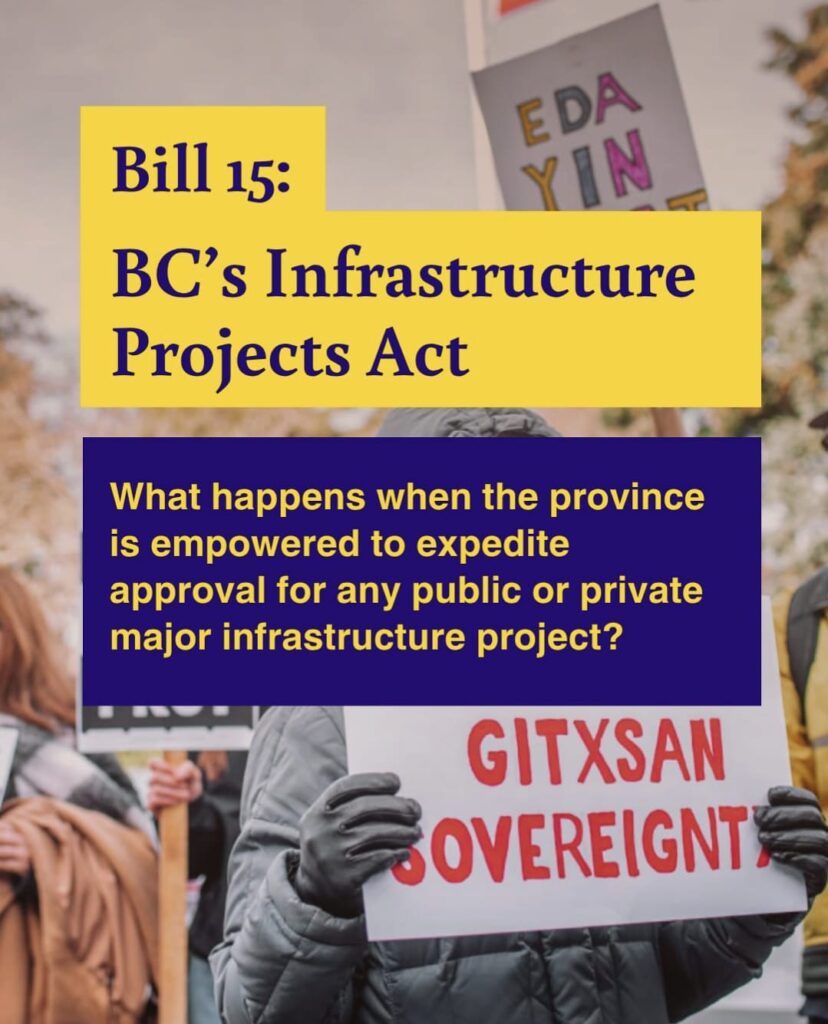
Bill 15 is the twin piece of legislation that accompanies Bill 14, the Renewable Energy Projects Streamlining Act, passed by David Eby’s NDP party through a narrow majority on May 28, 2025.
While Bill 14 focuses on renewable energy projects, Bill 15 has a much broader scope, granting the province power to fast-track approvals for any public or private major infrastructure project. This legislation could lead to severe project mismanagement and weakened environmental protections. Its vague language allows future governments to accelerate the approval of any other extractive infrastructure deemed important without clearly defined criteria. Specifically, it will grant the province’s Premier the ability to do so through amending pieces of BC’s 2003 Significant Projects Streamlining Act.
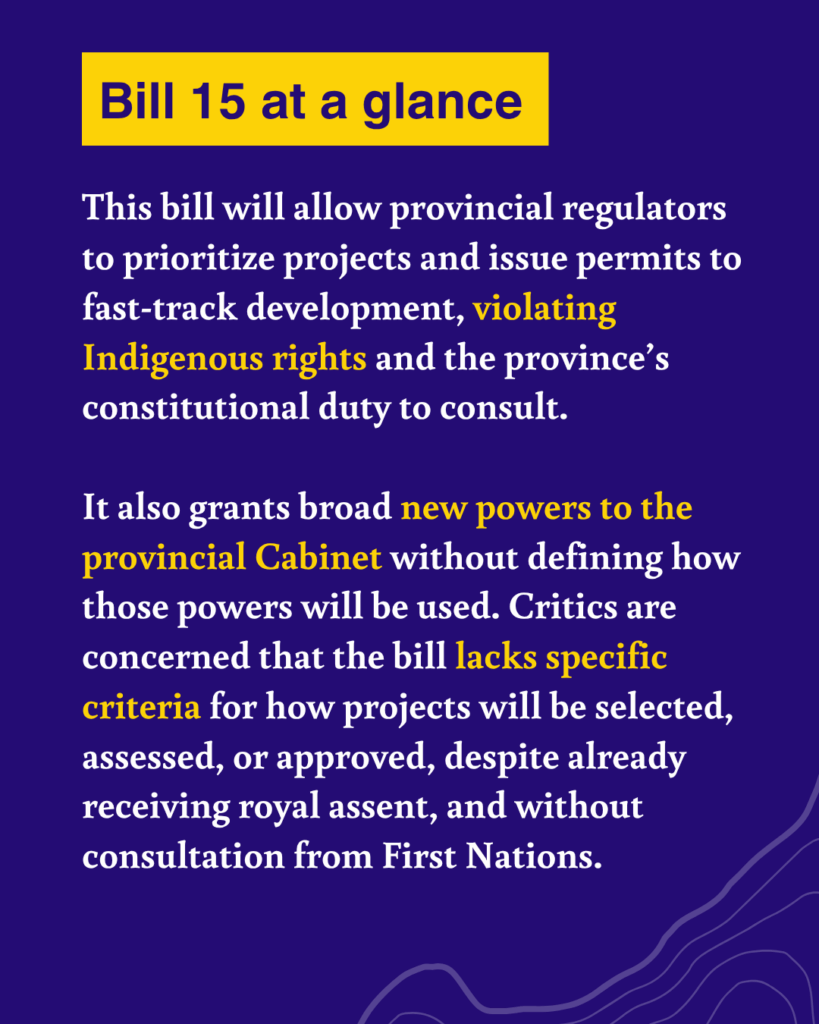
Parts 3 and 4 of the Act grant the province’s Ministers broad authority to “designate” projects as provincially significant (officially bringing them under the purview of this legislation). This enables them to (a) rely on “qualified professional” certification rather than government-led review; (b) prioritize their permitting; (c) exert new powers over the environmental/regulatory review process; (d) and use an expedited process for review.
The bill also grants broad new powers to the provincial Cabinet without defining how those powers will be used. Critics are concerned that the bill lacks specific criteria for how projects will be selected, assessed, or approved, despite it already having received royal assent without meaningful consultation from potentially impacted First Nations.
For example, the bill allows for the “varying” (i.e., changing or overriding) of other provincial legislation to expedite infrastructure projects. The Lieutenant Governor has decision-making authority to review these requests to make exemptions and modify regulations (found in Section 9). To push projects through faster, a facilitator may be appointed to determine whether it is “reasonable” to remove constraints that slow down the approval and of projects (found in Section 12). Ministers themselves may also be designated as project proponents.
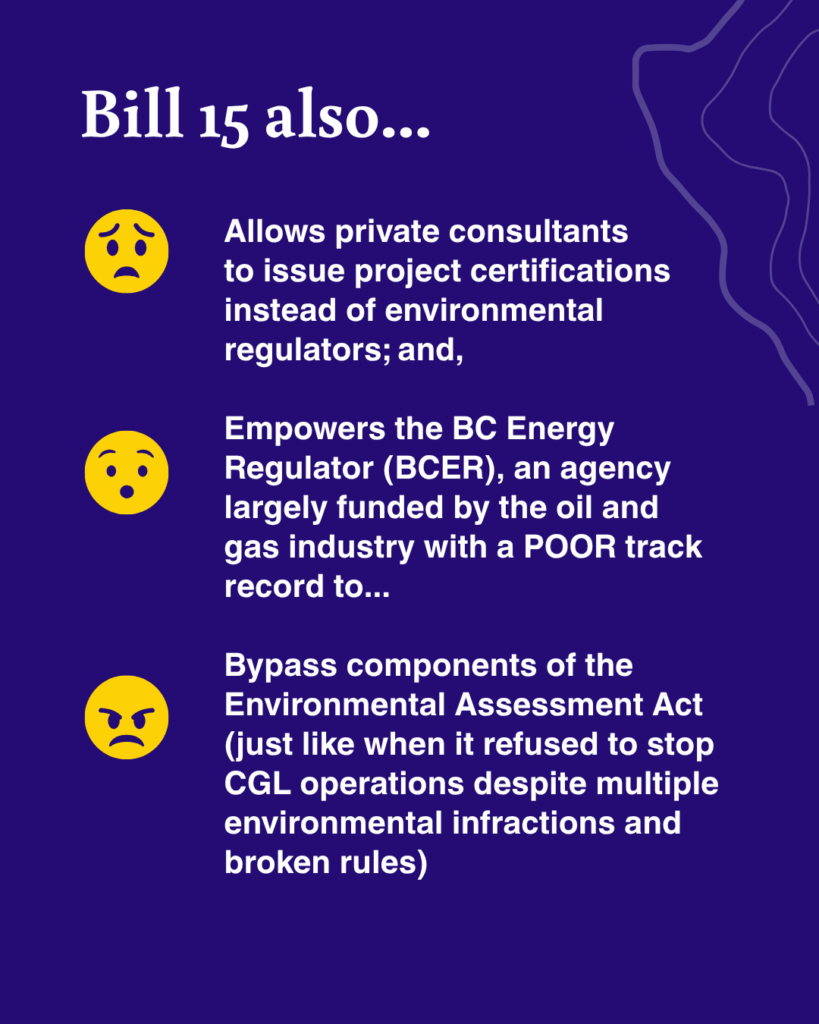
Bill 15 also expands the private sector’s influence on project approval through multiple avenues. Part 4, “Streamlining Designated Projects,” allows private consultants to issue project certifications instead of environmental regulators. Critics, including the UVic Environmental Law Centre, have raised alarm for over a decade about conflicts of interest in BC’s Qualified Professional system, where proponents hire their own scientists to conduct project studies. Bill 15 removes the limited existing oversight, effectively privatizing permitting by enabling proponent-paid consultants to approve their own projects.
The public scrutiny that major projects usually receive before breaking ground through environmental impact assessments could be cut short or completely bypassed by Bill 15. Despite its poor track record of environmental stewardship and policy enforcement, the legislation grants more authority to the BC Energy Regulator (BCER) to oversee and help in the fast-tracking of these energy projects. The BCER is an agency largely funded by the oil and gas industry, and allows it to ignore components of the Environmental Assessment Act. UVic Law professor Deborah Curran notes that the BCER was originally established to enable oil and gas development, a legacy evident in its dual roles as industry facilitator and compliance officer. For example the BCER repeatedly gave Coastal GasLink a pass on environmental infractions when building their pipeline through Wet’suwet’en territory.
The constitutional obligation to consult with impacted Indigenous nations or peoples prior to development is vague in the bill, at best. Premier Eby openly admitted that the Bill failed to meet the standard of consultation found in the province’s Declaration on the Rights of Indigenous Peoples Act. In a letter from days before the bill’s passage, the First Nation Leadership Council stated in an open letter:
Section 20 in Bill 15 and section 13(2) in Bill 14 are the only provisions that refer to the Declaration on the Rights of Indigenous Peoples Act (“Declaration Act”). Neither of those provisions state that the legislation cannot be interpreted in a manner inconsistent with the protections of the Declaration Act or UN Declaration. Rather, they merely adopt the definition of “Indigenous peoples” from the Declaration Act.
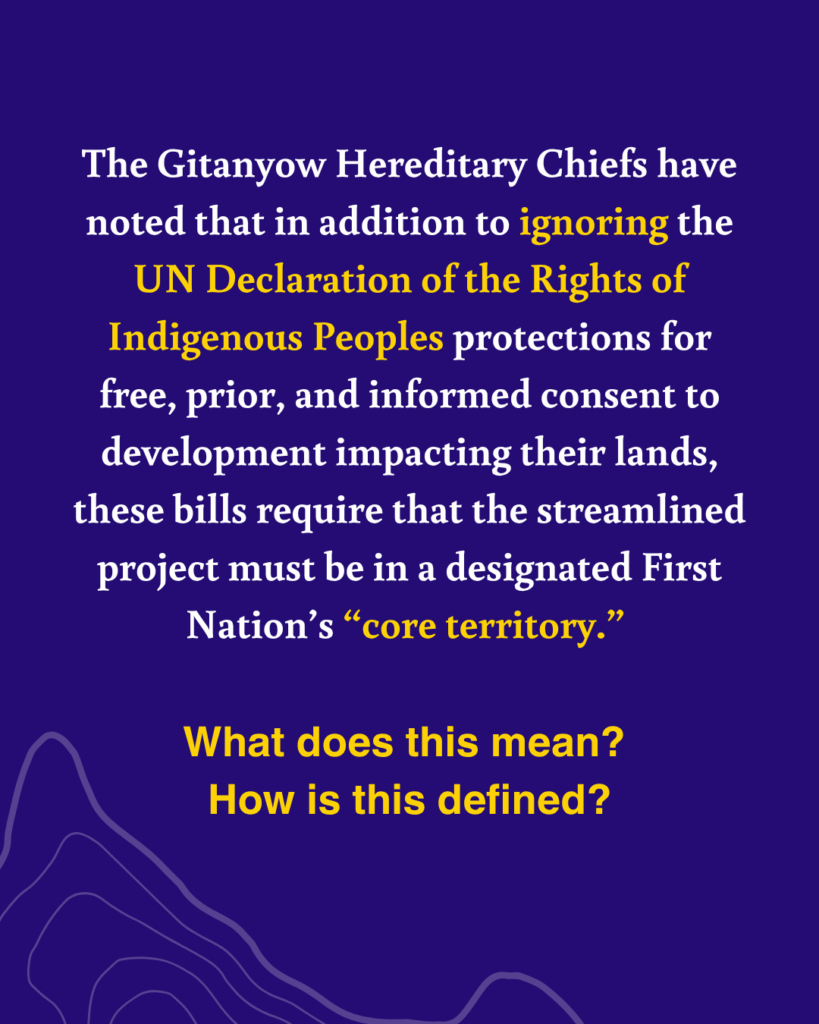
The Gitanyow Hereditary Chiefs reiterated these concerns and added their own:
- That the bills do not contain a requirement for consent from First Nations before a project can proceed or be designated for streamlining.
- That a project must be in a First Nation’s “core territory” before it can be designated for fast-tracking.
- No explanation has been provided as to what “core territory” means nor who will determine whether a project is, or is not, in a First Nation’s “core territory.” This approach seriously risks prejudicing the Gitanyow Hereditary Chiefs in our current efforts to have our Aboriginal title in the Lax’yip recognized by either agreement or court declaration.
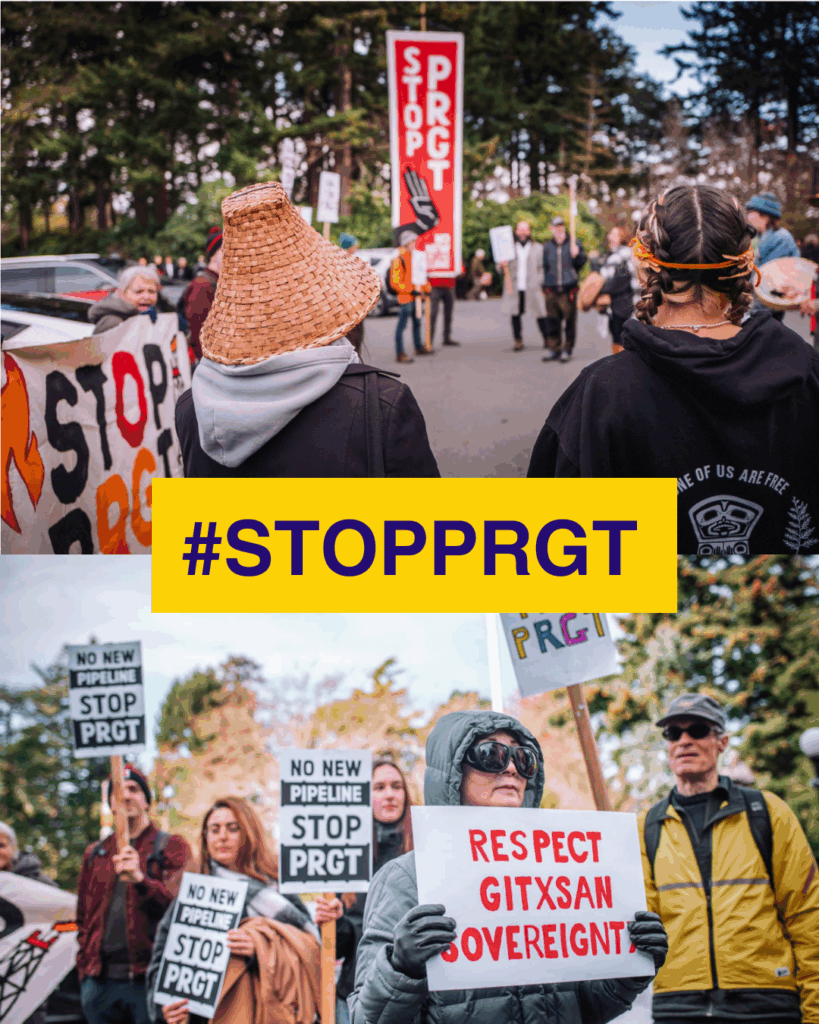
Hence, multiple Indigenous nations spokespeople, environmental groups, and politicians have made vocal opposition to the bill, including the Chief of Tsartlip First Nation and vice-president of the Union of B.C. Indian Chiefs, Don Tom, and former NDP MLA Melanie Mark.
BC’s Bills 14 and 15 are said to follow the same logic as other provinces’ decision to fast track projects and ignore environmental and labour law: to protect the province against the threat of US tariffs and improve the regional economy.
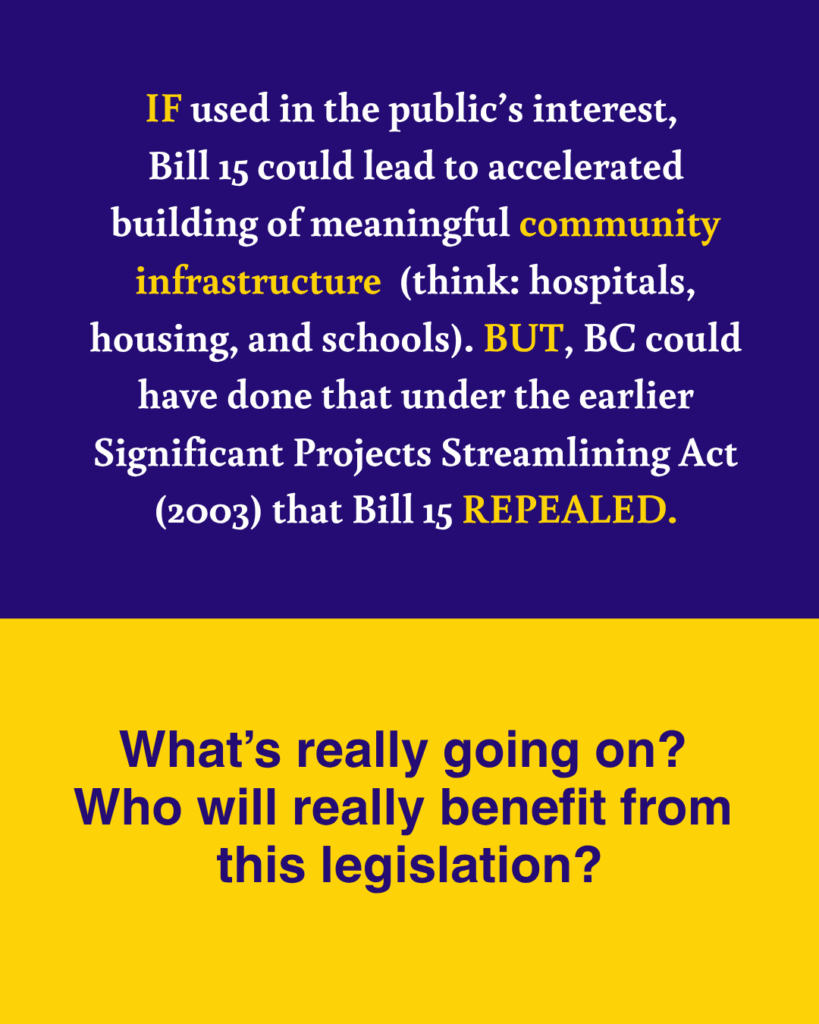
The Act certainly could help accelerate important community infrastructure development, like hospitals, schools, community centres and senior homes. But while the province claims Bill 15 will speed up housing construction, the Minister of Infrastructure specifically excluded “low-barrier housing” from its scope. This exclusion is striking given the NDP’s past efforts to build supportive housing and the province’s already existing but unused power to override municipal opposition under the repealed Significant Projects Streamlining Act—the only legislation repealed by Bill 15. Notably, this power was not used during the province’s recent fight to build supportive housing in Kitsilano in the face of NIMBYism.
By expanding these powers while excluding the most urgent housing needs for those who need it most, Bill 15 begs the question: if market solutions won’t provide homes people can afford, who will benefit from this legislation?
The Grand Bargain of expediting housing infrastructure by centralizing provincial power must also be reconciled with the development that could be expedited on Indigenous territories without the consent of title holders.