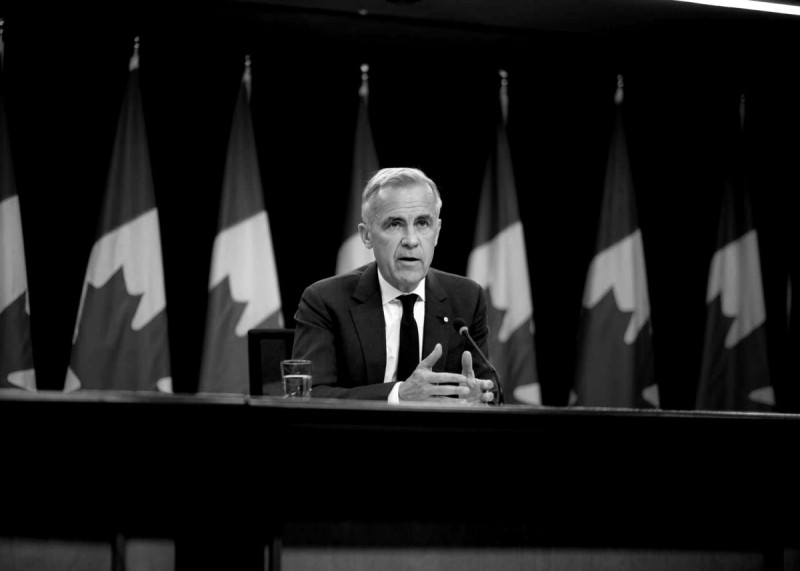
This omnibus legislation was introduced by Liberal Prime Minister Mark Carney June 6, 2025, and despite only seven days notice and two days of consultation with civil society and Indigenous groups, the bill was put to a vote on June 20, 2025. That day—the last sitting day of Parliament before the House of Commons recessed for a 3-month break—the bill was split into two parts and voted on separately. The bill passed with 306 votes and 31 opposed. It was supported by the Liberal and Conservative parties, with only one Liberal vote against it. On June 26, despite concerns expressed by many Senators, it was approved by the Senate and it now awaits royal assent.
What’s in the Building Canada Act?
The Building Canada Act is a major concern because of the incredible powers it confers on ministers to approve development projects and override existing law to fast-track them. The bill is promised “to enhance Canada’s prosperity, national security, economic security, national defence and national autonomy by ensuring that projects that are in the national interest are advanced through an accelerated process that enhances regulatory certainty and investor confidence, while protecting the environment and respecting the rights of Indigenous Peoples.” This “acceleration,” though, can mean removing hard-fought protection for environmental and Indigenous rights.
How does it do this? By concentrating power in the Privy Council Office (i.e., Prime Minister’s office) through a new Major Projects Office. On the recommendation of a single Minister, this Office may “deem” projects in the national interest and issue a Conditions Document, or National Interest Project Document, with all the federal authorizations for permit and approvals tucked inside that are required to move forward.
- For example, issuing a Fisheries Act permit, which would be required if the project was going to impact fish habitat, would normally mean that the Minister would have to consider various factors such as cumulative effects before making a decision. Now, the designated Minister can just “deem” these factors to have been considered.
- Similarly, considerations in the Species at Risk Act, the Canadian Navigable Waters Act, and others will also be made irrelevant
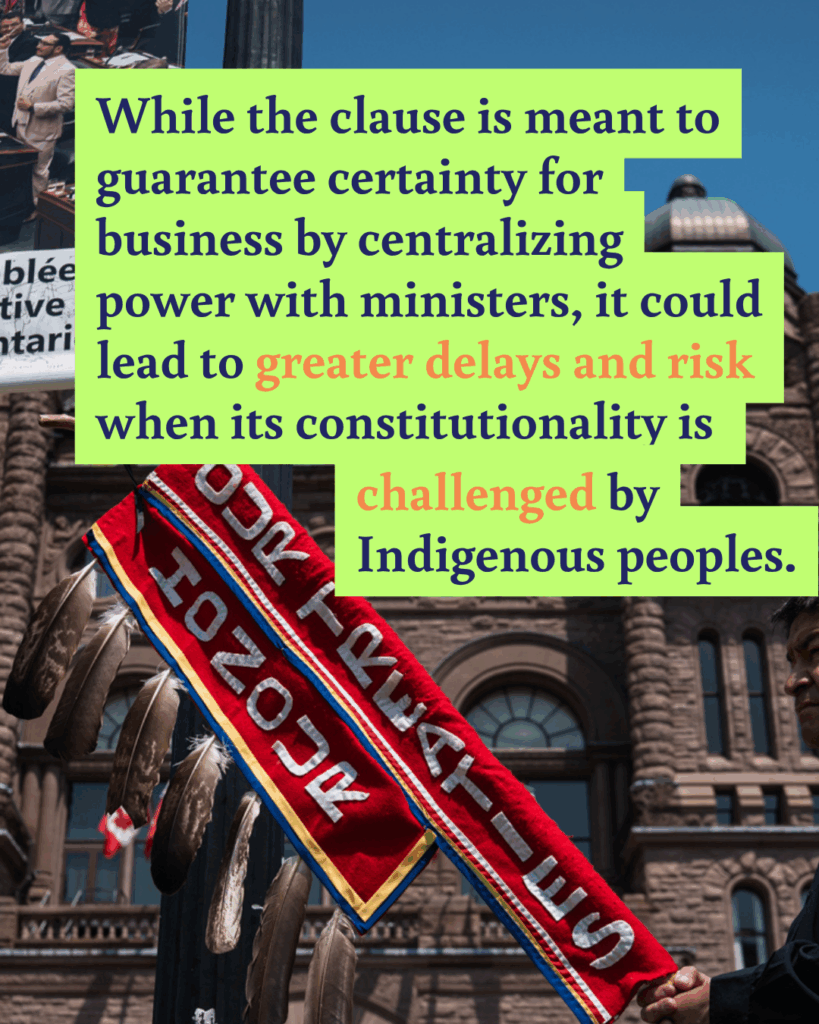
While the government states that it will require consultation with impacted Indigenous peoples before designating a project in the “national interest,” issuing the Conditions document or amending its conditions, the Act exempts national interest projects from the Impact Assessment Act’s planning phases, where, in practice, most consultation with Indigenous peoples takes place.
Indigenous peoples have been speaking out about other key aspects of the legislation their because of the risks it present to their constitutional and inherent rights:
- It violates Canada’s obligations under international law regarding the United Nations Declaration on the Rights of Indigenous Peoples (UNDRIP), BC’s DRIPA, and Canada’s UNDRIP implementation legislation (Bill C-15) by “pre-approving” projects which is designed to override consultation and consent of Indigenous peoples.
- Indigenous “interests” and climate change are only a couple among multiple considerations Ministers may make to consider fast-tracking projects. What about Indigenous constitutional and inherent rights, and UNDRIP and DRIPA principles of free prior and informed consent? None of these are specifically given priority under the legislation and economic interests look heavily weighted to prevail.
- Anticipated impacts to Indigenous lands are being “streamlined” out of the process by bypassing critical regulatory hurdles of environmental assessment acts and other environmental protections.
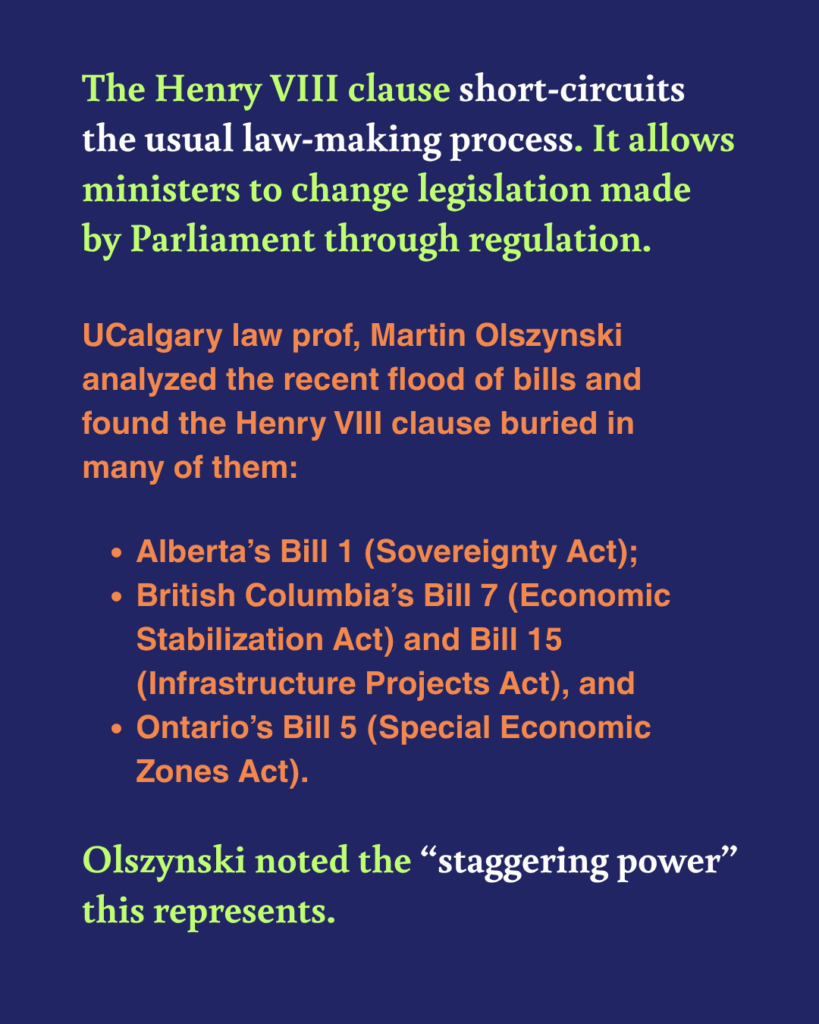
- The Act contains the arcane Henry VIII clause, which allows Cabinet Ministers to make regulations that authorize the bypassing of otherwise applicable laws, essentially shielding designated projects from review, and therefore exempting further deregulation from any judicial challenge.

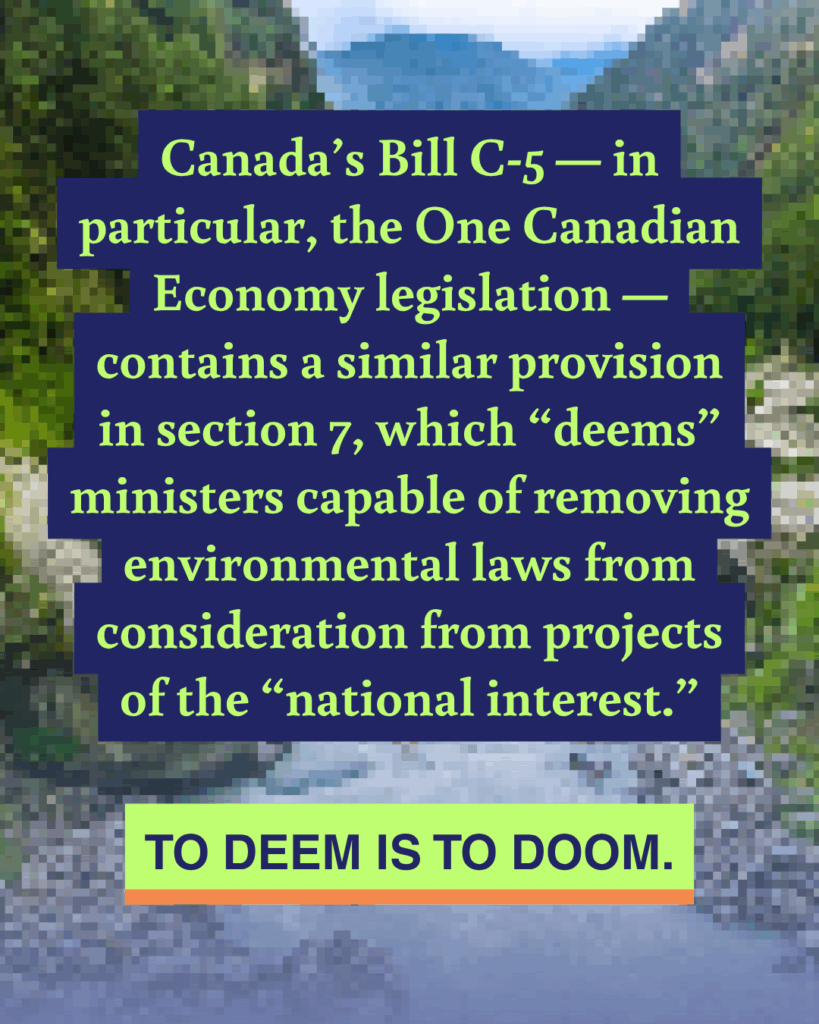
Carney has promised that a set of vague “criteria” will determine whether a project can be deemed in the “national interest” and therefore subject to accelerated approvals. Once “deemed” by a Minister to be in the “national interest,” the Conditions Document can be issued.
Despite promises of “clean growth,” Carney has been harping about “decarbonized oil”, referencing the tar sands as a key example of what he’s planning. ‘Decarbonized oil’ is a completely made-up industry term that has no meaning in terms of environmental targets or green growth.
It is highly doubtful that this legislation will be used to fast track much-needed green energy, climate resilience, affordable housing, and other necessary projects. And as the Narwhal reports, the fast-tracking of projects can lead to disastrous outcomes. West Coast Environmental Law has also issued a report noting the need for robust assessment processes in order to create sustainable infrastructure.
But most of all, do we want all this power centralized in the Privy Council Office? Do we want the protection of biodiversity and healthy fisheries to be seen as barriers to “growth”? Do we want Indigenous peoples to be an afterthought to major project planning? Do we want climate policy on the backburner as wildfires rage across the country?
What’s in the One Canadian Economy Act?
The bill’s long title is, One Canadian Economy: An Act to enact the Free Trade and Labour Mobility in Canada Act. This act is promised to improve intraprovincial cross-border trade and labour mobility within Canada through the principle of mutual recognition of regulations. This mutual recognition process could mean provinces and territories would be forced to accept, according to critical policy analysts, “the least stringent regulations for safety, environmental protection, and consumer protection.” In this way, it could undermine worker, environmental, and consumer protections.
Professor Mark S. Winfield, Co-Chair, Sustainable Energy Initiative at York University, describes this race to the bottom as the opposite of the “California effect,” which raised environmental standards in other states by maintaining high regulatory thresholds in California required for trade.
For this reason, labour unions have been fighting back. Unifor President Lana Payne wrote:
Let’s be clear: there are no tariffs blocking internal trade in Canada. Instead, “internal trade barriers” are often code for regulation—including health and safety rules, occupational credentials, local hiring policies, public ownership models, consultation and cooperation requirements with First Nations, Metis and Inuit populations, community benefit requirements, or special collective bargaining rights like those in the Newfoundland fisheries. These aren’t inconveniences, and they are hardly “red tape” —they’re hard-won policies that protect workers, communities, and our public interest.
Payne called this Act a move towards the “lowest common denominator” of regulatory standards. This regulatory downslide seems to have little to do with actual trade barriers. Interprovincial trade across Canada was up 44 percent in 2021, since 2007: a whopping $451 billion in revenue, with no sign of the lost billions being decried.
Currently, provinces are negotiating agreements with another, and we are staying tuned to what the results and impacts may be.